

Thatcher understood Washington’s 1989 invasion was illegal but supported it anyway, recently declassified documents show, John McEvoy reports.
Shortly before 7 a.m. on Dec. 20, 1989, Margaret Thatcher received a call from U.S. President George H.W. Bush.
Bush informed the U.K. prime minister that Washington had just launched an invasion of Panama, declaring that there had been “no alternative but to intervene.”
After decades on the C.I.A.’s payroll, Panama’s military leader Manuel Antonio Noriega had fallen out of favour with the White House, and the Bush administration decided it was time for him to go.
That morning, over 20,000 U.S. troops descended on Panama, accompanied by the indiscriminate bombing of poor civilian areas thought to be Noriega strong-holds.
According to human rights organisations, up to 3,000 Panamanian civilians may have been killed during the invasion, with tens of thousands more displaced. The true figure of civilian casualties remains unknown — the U.S. forces didn’t bother to count the dead, with many thrown into mass graves.
Thatcher was the first foreign leader to be told of the operation.
Over the phone, she assured Bush that “it was a very courageous decision which would have our full support.” Britain would “take the line that it was no good people criticising Noriega and then failing to support the Americans”.
Over the following weeks, the Thatcher government stood alone in its unequivocal support for the U.S., despite concerns over the legality of the invasion. “Bang — just like that,” was how Thatcher described her decision to back Bush.
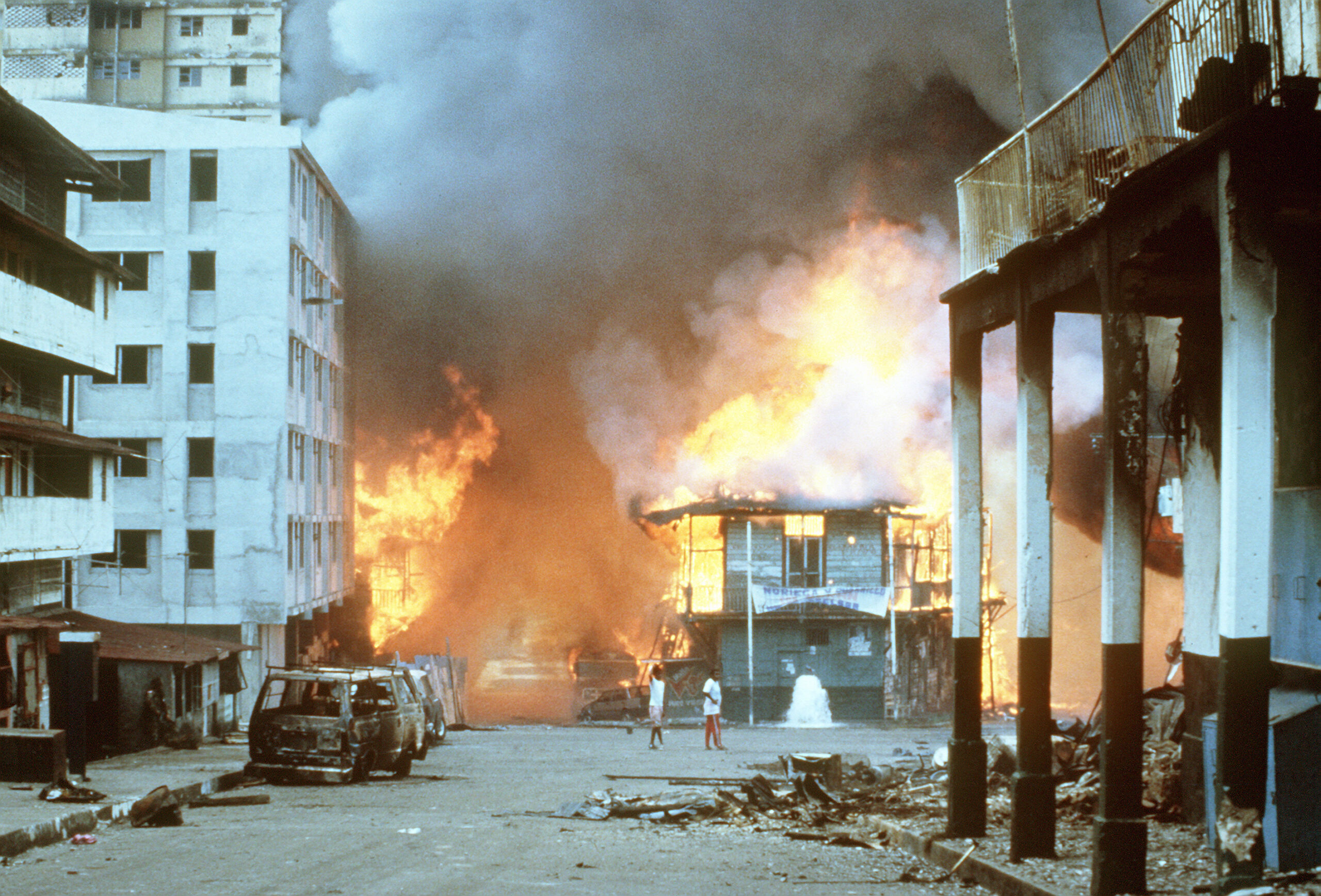
U.S. military invasion of Panama in 1989. (Wikimedia Commons)
From Asset to Liability
The White House had not always treated Noriega as an adversary.
Throughout the Cold War, he had been a valuable C.I.A. asset – from snitching on Peruvian military students in the 1950s to running covert operations in support of the Contras’ war against the Nicaraguan government in the 1980s.
In June 1986, however, journalist Seymour Hersh revealed that the Panamanian military leader was “extensively involved in illicit money laundering and drug activities.” On top of this, Noriega had been “providing intelligence information simultaneously to Cuba and the United States.”
Public knowledge of Noriega’s drug links turned him from an asset to a liability, and the White House came under increasing pressure to act. Moreover, Noriega’s links with Cuban intelligence suggested he could no longer be trusted to do Washington’s bidding — a serious concern given the strategic importance of the Panama Canal.

Panama’s Gen. Manuel Noriega being taken onto a U.S. Air Force aircraft by agents from the U.S. Drug Enforcement Agency after his arrest on Jan. 1, 1990. (U.S Air Force, Public Domain, Wikimedia Commons)
Still, three months after Noriega’s drug links were revealed, the Panamanian leader met with U.S. National Security Council official Oliver North in a London hotel “to collaborate on a plan for Noriega to support the Contras in return for American money and arms.”
In response to a Freedom of Information request, the U.K. Foreign Office claimed that it holds no record of Noriega’s visit to the U.K. However, it seems unlikely that British intelligence knew nothing of what was happening.
The Lady is for Turning
By the time of Bush’s election in November 1988, the U.S. had decidedly turned on Noriega. That year, the Ronald Reagan administration imposed crippling sanctions on Panama and indicted Noriega on drug-trafficking offences.
Even as Washington turned up the heat on Noriega, the British government opposed both military intervention and sanctions.
In September 1989, Thatcher held a meeting in Downing Street with Panamanian opposition figure Guillermo Ford and agreed with him that the international community should continue to ostracise Noriega.
But “she did not think intervention would be the right way forward. It would do the United States no good in Latin America. Nor did she think violence within Panama would help.”
Thatcher added that “the best way to get rid of Noriega was by constant pressure from opinion both from inside Panama and from other governments.”
The same month, a private U.K. foreign office brief recommended that Foreign Secretary John Major explain to the U.S. “our objection to economic sanctions” on Panama: “generalised economic sanctions would serve no purpose; hurt the innocent more than the guilty.”
Thatcher’s opposition to intervention in Panama would not last — the lady, it seems, was for turning.
‘Operation Just Cause’
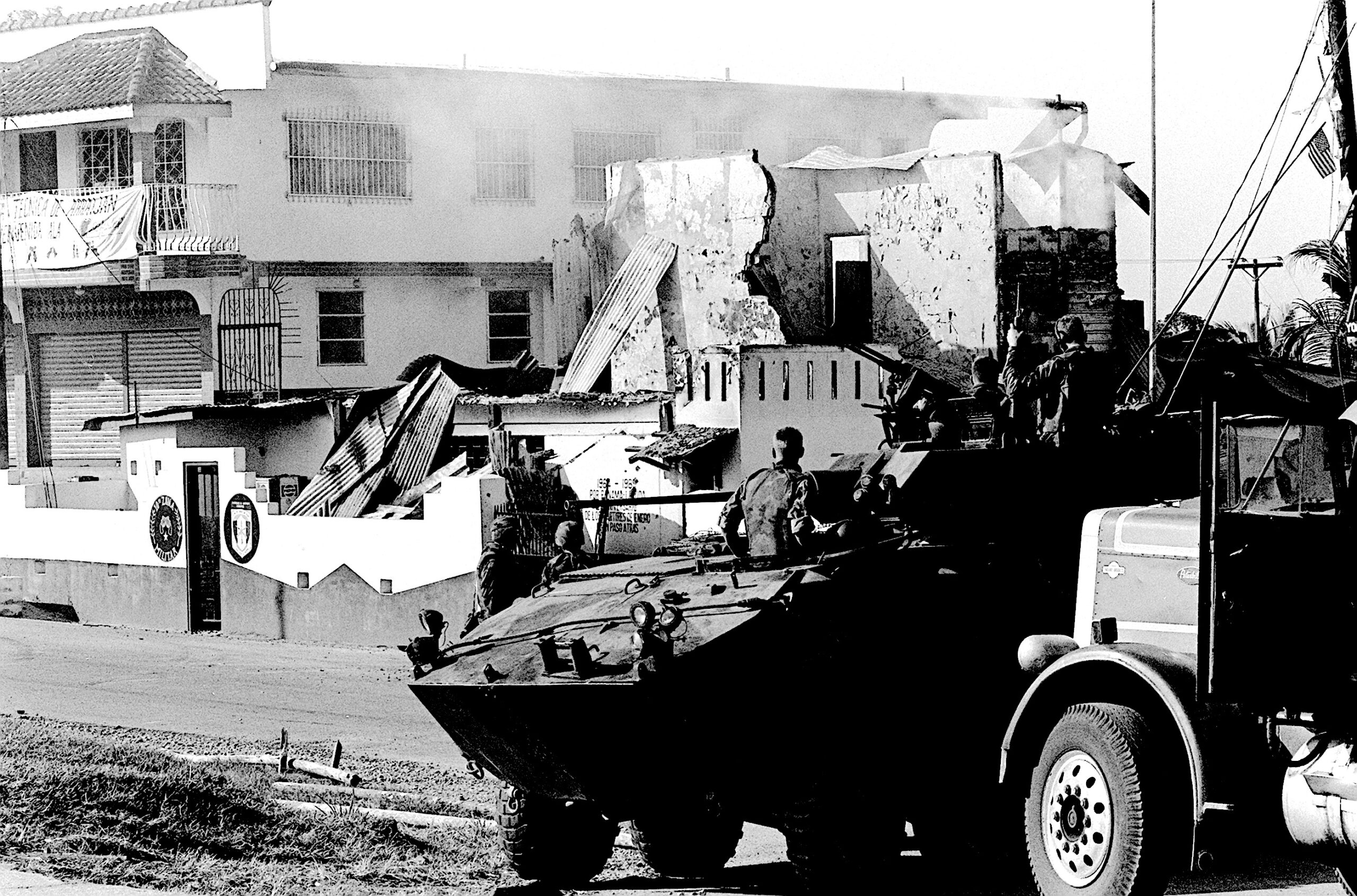
U.S. Marines outside a destroyed Panamanian Defense Force building during the first day of the U.S. invasion, Dec. 20, 1989. (DoD, PH1 Elliott, Wikimedia Commons)
On Dec. 20, 1989, Bush launched “Operation Just Cause,” justifying the invasion of Panama on four grounds: to restore democracy to Panama; to arrest Noriega; to protect U.S. rights under the Panama Canal Treaty; and to protect U.S. nationals in Panama.
In reality, Noriega’s subservience to the U.S. had come into question, and Bush viewed intervention in Panama as an opportunity to shake off claims that he was a “wimp.” Indeed, Noriega’s election rigging, persecution of political opponents and drug links had not been a serious concern while he worked as a U.S. asset.
On Bush’s orders, the U.S. thus “mesmerised” Panama “with firepower,” using “new gadgets, laser-guided missiles and stealth fighters,” new technologies which the U.S. was “just dying to use,” as U.S. General Marc Cisneros recalled.
Two weeks after the invasion, Noriega surrendered himself to U.S. forces. He was put on trial in a Miami court, which prevented his defence from presenting any evidence relating to his work for the C.I.A., or links with senior U.S. officials including Bush.
Back in Panama, Guillermo Endara was installed as Noriega’s successor. He oversaw the return of competitive elections in Panama, though the country remained a key if not more important player in the Latin American drug trade.
Legal Doubts
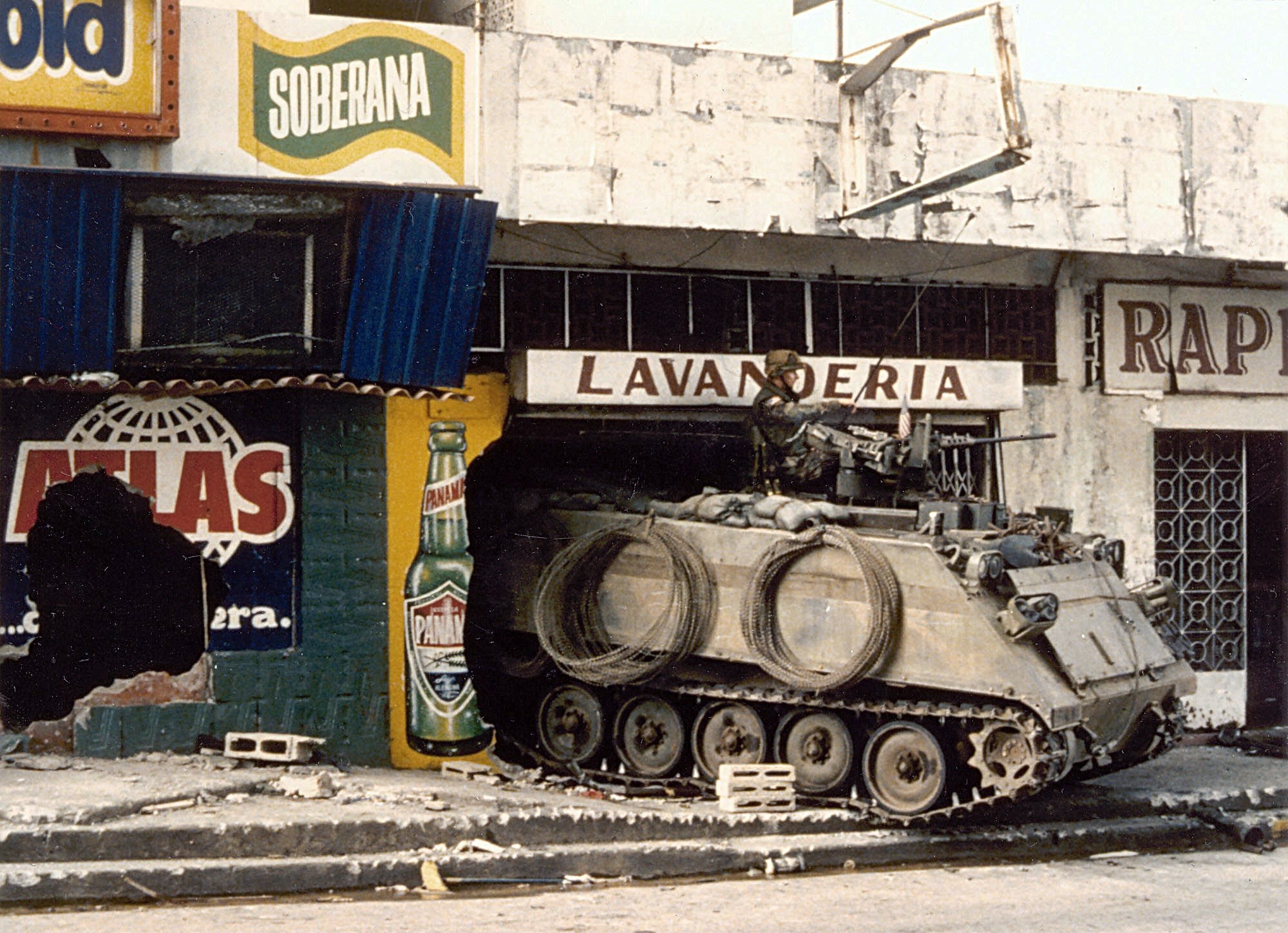
Dec. 21, 1989: U.S. armored personnel carrier guards a street near the destroyed Panamanian Defense Force headquarters building during the second day of the U.S. invasion. (DoD, J. Elliott, Public Domain, Wikimedia Commons)
Even on the grounds given by Bush, British legal advisers doubted whether the invasion could be justified under international law and strongly encouraged officials not to comment on matters of legality.
On the day of the invasion, Foreign Office legal adviser Sir Arthur Watts wrote to Adrian Beamish, the assistant under secretary of state for the Americas, about his concerns.
“On the facts as we know them it is not possible to conclude that the American action was justified in international law,” Watts noted. In particular, he wrote there could be “no justification in international law” for the U.S. claim to be restoring democracy in Panama or for its seizure of Noriega.
He added: “My strong advice is that we should not be drawn into expressing a view one way or the other on the legality of the American action.”
The next year, Anthony Aust, a legal adviser to the U.K. mission to the U.N., compared the U.S. invasion of Panama to that of Grenada in 1983.
“On that occasion also there were four or five different legal grounds given, none of which was convincing on its own. Taken together they were even less convincing,” he wrote.
Indeed, the U.S. invasion of Panama was widely considered to be illegal and in violation of the charters of the United Nations and the Organization of American States.
Washington Was Grateful
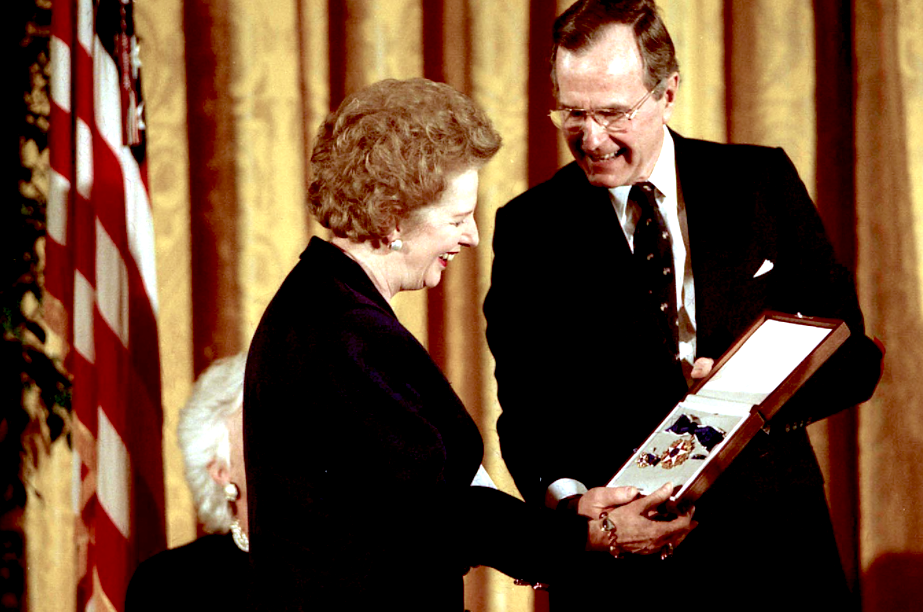
July 3, 1991: President George H. Bush presents the Presidential Medal of Freedom to former British Prime Minister Margaret Thatcher. (U.S. National Archives)
Legal concerns notwithstanding, Thatcher came out batting for the U.S. more than any other political leader.
On the morning of the invasion, the prime minister stood outside Downing Street and told reporters that Bush’s decision to invade had been “courageous,” adding: “I believe this is what friends are for — to support at this time.”
In the following days, Britain vetoed a U.N. Security Council resolution which “strongly deplores the intervention in Panama by the armed forces of the United States of America, which constitutes a flagrant violation of international law and of the independence, sovereignty and territorial integrity of States.”
This was the last time that the U.K. government used its veto at the UN Security Council.
Britain’s representative to the U.N., Thomas L. Richardson, declared that the U.K. government “fully support[s] the action taken by the United States,” taking the U.S. at its word that “all feasible measures have been taken to minimise the risk of civilian damage or casualties.”
Washington was grateful.
Shortly after the Security Council vote, it was noted that Britain’s “early and unswerving support for the U.S. intervention went down very well in Washington. Although France joined the U.K. and U.S. in vetoing a hostile Security Council Resolution only we have given unequivocal support to the Americans.”
So unswerving was Britain’s support for the U.S. that Douglas Hurd, then U.K. foreign secretary, privately worried that “it will look as though we are just following the Americans.”
Indeed, this was effectively the case. As Thatcher later recalled: “When President Bush was in trouble about Panama, he rang me, he got support. Bang – just like that… Where else did he get it from?”
John McEvoy is an independent journalist who has written for International History Review, The Canary, Tribune Magazine, Jacobin and Brasil Wire.
This article is from Declassified UK.