

The North Atlantic Treaty Organisation ‘s communiqué released after the first day of its annual summit earlier this month claimed that “NATO is a defensive alliance,” a statement encapsulating why many struggle to grasp its essence.
A look at the latest military spending figures shows, to the contrary, that NATO countries, and countries closely allied to NATO, account for nearly three-quarters of the total annual global expenditure on weapons.
Many of these countries possess state-of-the-art weapons systems, which are qualitatively more destructive than those held by the militaries of most non-NATO countries.
Over the past quarter century, NATO has used its military might to destroy several states, such as Afghanistan (2001) and Libya (2011), shattering societies with the raw muscle of its aggressive alliance. It ended Yugoslavia (1999) as a unified state. It is difficult, given this record, to sustain the view that NATO is a “defensive alliance.”
Currently, NATO has 31 member states, the most recent addition being Finland, which joined in April. Its membership has more than doubled since its 12 founding members (all European and North American nations that had been part of the war against the Axis powers) signed its founding Washington or the North Atlantic Treaty on April 4, 1949.
It is telling that one of these original members — Portugal — remained under a fascist dictatorship at the time, known as Estado Novo (in place from 1933 until 1974).
Article 10 of the treaty declares that NATO members — “by unanimous agreement” — can “invite any other European state” to join the military alliance. Based on that principle, NATO welcomed Greece and Turkey (1952), West Germany (1955) and Spain (1982), expanding its membership at the time to include 16 countries.
Doubling Down
The disintegration of the U.S.S.R. and communist states in Eastern Europe — the purported threat that compelled the need for NATO to begin with — did not put an end to the need for the alliance.
Instead, NATO’s increasing membership has doubled down on its ambition to use its military power, through Article 5, to subdue anyone who challenges the “Atlantic Alliance.”

Nino Morbedadze, Georgia, “Strolling Couple,” 2017.
The “Atlantic Alliance,” a phrase that is part of NATO’s name, was part of a wider network of military treaties secured by the U.S. against the U.S.S.R. and, after October 1949, against the People’s Republic of China.
This network included the Manila Pact of September 1954, which created the Southeast Asian Treaty Organisation (SEATO), and the Baghdad Pact of February 1955, which created the Central Treaty Organisation (CENTO).
Turkey and Pakistan signed a military agreement in April 1954, which brought them together in an alliance against the U.S.S.R. and anchored this network through NATO’s southernmost member (Turkey) and SEATO’s westernmost member (Pakistan).
The U.S. signed a military deal with each of the members of CENTO and SEATO and ensured that it had a seat at the table in these structures.
Nehru’s Prescience
At the Asian-African Conference in Bandung, Indonesia, in April 1955, India’s Prime Minister Jawaharlal Nehru reacted strongly to the creation of these military alliances, which exported tensions between the U.S. and the U.S.S.R. across Asia.
The concept of NATO, he said, “has extended itself in two ways”: first, NATO “has gone far away from the Atlantic and has reached other oceans and seas” and second, “NATO today is one of the most powerful protectors of colonialism.”
As an example, Nehru pointed to Goa, which was still held by fascist Portugal and whose grip had been validated by NATO members — an act, Nehru said, of “gross impertinence.” This characterisation of NATO as a global belligerent and defender of colonialism remains, with some modifications.
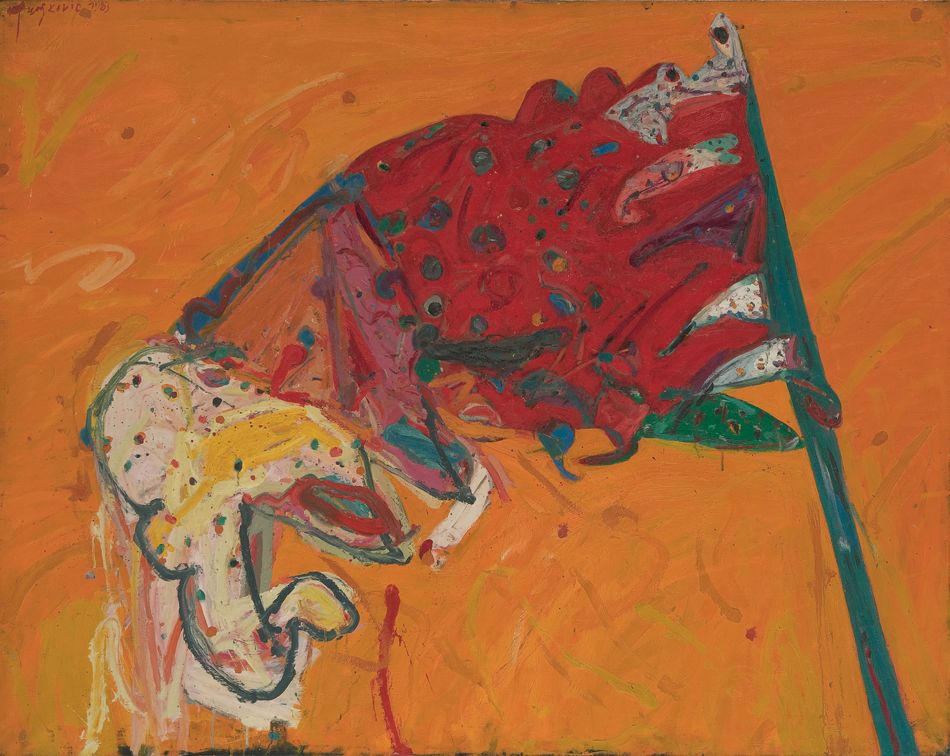
Slobodan Trajkovic, Yugoslavia, “The Flag,” 1983.
SEATO was disbanded in 1977, partly due to the defeat of the U.S. in Vietnam, and CENTO was shuttered in 1979, precisely due to the Iranian Revolution that year.
U.S. military strategy shifted its focus, from wielding these kinds of pacts, to establishing a direct military presence with the founding of U.S. Central Command in 1983 and the revitalisation of the U.S. Pacific Command that same year.
The U.S. expanded the power of its own global military footprint including its ability to strike anywhere on the planet due to its military bases and armed flotillas (which were no longer restricted once the 1930 Second London Naval Treaty expired in 1939).
Although NATO has always had global ambitions, the alliance was given material reality through the U.S. military’s force projection and its creation of new structures that further tied allied states into its orbit (with programmes such as “Partnership for Peace,” set up in 1994, and concepts such as “global NATO partner” and “non-NATO ally,” as exemplified by Japan and South Korea).
In its 1991 “Strategic Concept,” NATO wrote that it would “contribute to global stability and peace by providing forces for United Nations missions,” realised with deadly force in Yugoslavia (1999), Afghanistan (2003) and Libya (2011).
By the Riga Summit (2006), NATO was confident that it operated “from Afghanistan to the Balkans and from the Mediterranean Sea to Darfur.”
Nehru’s focus on colonialism might seem anachronistic now, but in fact, NATO has become an instrument to blunt the global majority’s desire for sovereignty and dignity, two key anti-colonial concepts. Any popular project that exerts these two concepts finds itself at the end of a NATO weapons system.
Post-Cold War NATO

Shefa Salem al-Baraesi, Libya, “Kaska, Dance of War,” 2020.
The collapse of the U.S.S.R. and the Eastern European communist state system transformed Europe’s reality.
NATO quickly ignored the “ironclad guarantees” offered by U.S. Secretary of State James Baker to Soviet Foreign Minister Eduard Shevardnadze in Moscow on Feb. 9, 1990 that NATO’s “forces would not move eastward” of the German border.
Several states that bordered the NATO zone suffered greatly in the immediate period of the fall of the Berlin Wall, with economies in the doldrums as privatisation eclipsed the possibility for their populations to live with dignity.
Many states in Eastern Europe, desperate to enter the European Union that least promised access to the common market, understood that entry into NATO was the price of admission.
In 1999, Czechia, Hungary and Poland joined NATO, followed in 2004 by the Baltic states (Estonia, Latvia and Lithuania), Bulgaria, Romania, Slovenia and Slovakia. Eager for investments and markets, by 2004 many of these countries waltzed into the Atlantic Alliance of NATO and the EU.
NATO continued to expand, absorbing Albania and Croatia in 2009, Montenegro in 2017 and North Macedonia in 2020.
However, the breakdown of some U.S. banks, the waning attraction of the U.S. as the market of last resort, and the entry of the Atlantic world into a relentless economic depression after 2007 changed the context.
No longer were Atlantic states reliable as investors or as markets. After 2008, infrastructure investment in the EU declined by 75 percent due to reduced public spending and the European Investment Bank warned that government investment would hit a 25-year low.
The New Enemy: China

ArtLords — including Kabir Mokamel, Abdul Hakim Maqsodi, Meher Agha Sultani, Omaid Sharifi, Yama Farhard, Negina Azimi, Enayat Hikmat, Zahid Amini, Ali Hashimi, Mohammad Razeq Meherpour, Abdul Razaq Hashemi, and Nadima Rustam — “The Unseen Afghanistan,” 2021.
The arrival of Chinese investment and the possibility of integration with the Chinese economy began to reorient many economies, particularly in Central and Eastern Europe, away from the Atlantic.
In 2012, the first summit among China and Central and Eastern European countries (China–CEEC summit) was held in Warsaw, with 16 countries in the region participating.
The process eventually drew in 15 NATO members, including Albania, Bulgaria, Croatia, Czechia, Estonia, Greece, Hungary, Latvia, Lithuania, North Macedonia, Montenegro, Poland, Romania, Slovakia and Slovenia in 2021.
In 2022, Estonia, Latvia, and Lithuania withdrew from the initiative. In March 2015, six then-EU member states — France, Germany, Italy, Luxemburg, Sweden, and the U.K. — joined the Beijing-based Asian Infrastructure Investment Bank.
Four years later, Italy became the first G7 country to join the Belt and Road Initiative (BRI). Two-thirds of EU member states are now part of the BRI, and the EU concluded the Comprehensive Agreement on Investment in 2020.
These manoeuvres towards China threatened to weaken the Atlantic Alliance, with the U.S. describing China as a “strategic competitor” in its 2018 “National Defense Strategy” — a phrase indicative of its shifting focus on the so-called threat of China.
Nonetheless, as recently as November 2019, NATO Secretary-General Jens Stoltenberg said that
“there [are] no plans, no proposal, no intention to move NATO into, for instance, the South China Sea.”
However, by 2020, the mood had changed: a mere seven months later, Stoltenberg said,
“NATO does not see China as the new enemy or an adversary. But what we see is that the rise of China is fundamentally changing the global balance of power.”
NATO’s response has been to work with its partners — including Australia, Japan, New Zealand, and South Korea — “to address… the security consequences of the rise of China,” Stoltenberg continued.
The talk of a global NATO and an Asian NATO is front and centre in these deliberations, with Stoltenberg stating in Vilnius that the idea of a liaison office in Japan is “on the table.”
The Impact of Ukraine
The war in Ukraine provided new life to the Atlantic Alliance, driving several hesitant European countries — such as Sweden — into its ranks. Yet, even amongst people living within NATO countries there are groups who are sceptical of the alliance’s aims, with the Vilnius summit marked by anti-NATO protests.
The Vilnius Summit Communiqué underlined Ukraine’s path into NATO and sharpened NATO’s self-defined universalism. The communiqué declares, for instance, that China challenges “our interests, security, and values,” with the word “our” claiming to represent not only NATO countries but the entire international order.
Slowly, NATO is positioning itself as a substitute for the U.N., suggesting that it — and not the actual international community — is the arbiter and guardian of the world’s “interests, security, and values.”
This view is contested by the vast majority of the world’s peoples, 7 billion of whom do not even reside in NATO’s member countries (whose total population is less than one billion). Those billions wonder why it is that NATO wants to supplant the United Nations.
Vijay Prashad is an Indian historian, editor and journalist. He is a writing fellow and chief correspondent at Globetrotter. He is an editor of LeftWord Books and the director of Tricontinental: Institute for Social Research. He is a senior non-resident fellow at Chongyang Institute for Financial Studies, Renmin University of China. He has written more than 20 books, including The Darker Nations and The Poorer Nations. His latest books are Struggle Makes Us Human: Learning from Movements for Socialism and, with Noam Chomsky, The Withdrawal: Iraq, Libya, Afghanistan and the Fragility of U.S. Power.