

Niger has become the latest country in West Africa where the army has seized control, following Burkina Faso, Guinea, Mali, and Chad – all former French colonies. Since 1990, a striking 78% of the 27 coups in sub-Saharan Africa have occurred in Francophone states leading some commentators to ask whether France – or the legacy of French colonialism – is to blame?
Many of the coup plotters would certainly like us to think so. Colonel Abdoulaye Maiga, who was named prime minister by the military junta in Mali in September 2022, launched a scathing attack on France.
Criticising “neocolonialist, condescending, paternalist and vengeful policies”, Mr Maiga alleged that France had “disowned universal moral values” and stabbed Mali “in the back”.
Anti-French vitriol has also flourished in Burkina Faso, where the military government ended a long-standing accord that allowed French troops to operate in the country in February, giving France one month to remove its forces.
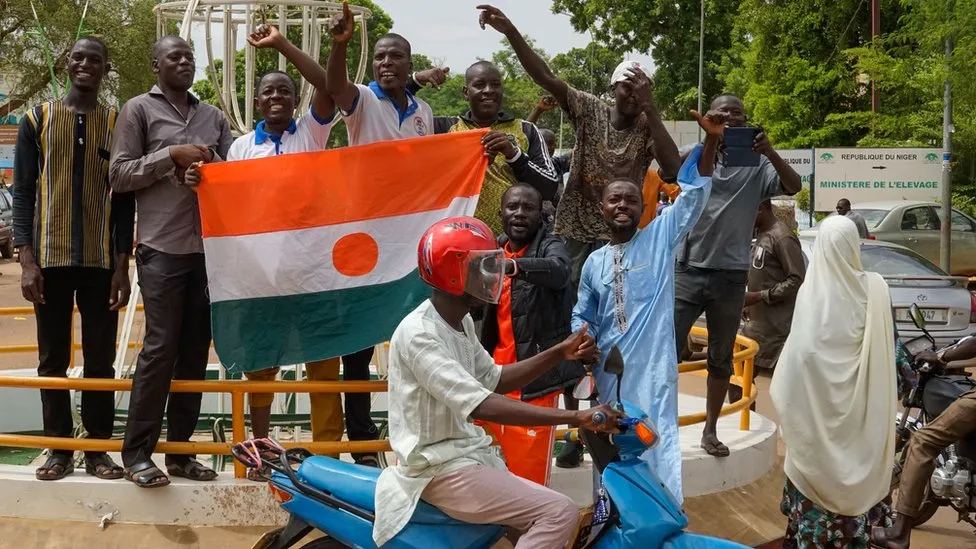
In Niger, which neighbours both countries, allegations that President Mohamed Bazoum was a puppet for French interests were used to legitimise his removal from power, and five military deals with France have since been revoked by the junta led by Gen Abdourahmane Tchiani. Partly as a result, the coup was followed by popular protests and attacks on the French embassy.
The historical record provides some support for these grievances. French colonial rule established political systems designed to extract valuable resources while using repressive strategies to retain control.
So did British colonial rule, but what was distinctive about France’s role in Africa was the extent to which it continued to engage – its critics would say meddle – in the politics and economics of its former territories after independence.
Seven of the nine Francophone states in West Africa still use the CFA franc, which is pegged to the euro and guaranteed by France, as their currency, a legacy of French economic policy towards its colonies.
France also forged defence agreements that saw it regularly intervene militarily on behalf of unpopular pro-French leaders to keep them in power.
In many cases, this strengthened the hand of corrupt and abusive figures such as Chad’s former President Idriss Déby and former Burkinabe President Blaise Compaoré, creating additional challenges for the struggle for democracy.
Although France did not intervene militarily to reinstate any of the recently deposed heads of state, all were seen as being “pro-French”.
Worse still, the relationship between French political leaders and their allies in Africa was often corrupt, creating a powerful and wealthy elite at the expense of African citizens.
François-Xavier Verschave, a prominent French economist, coined the term Françafrique to refer to a neocolonial relationship hidden by “the secret criminality in the upper echelons of French politics and economy”. These ties, he alleged, resulted in large sums of money being “misappropriated”.
Although recent French governments have sought to distance themselves from Françafrique, there are constant reminders of the problematic relations between France, French business interests and Africa, including a number of embarrassing corruption cases.
It is therefore easy to understand why one Nigerien told the BBC that: “Since childhood, I’ve been opposed to France… They’ve exploited all the riches of my country such as uranium, petrol and gold.”
Such scandals were often swept under the carpet while France’s African political allies were strong, and France’s military support helped to maintain stability.
In recent years, the ability of France and other Western states to ensure order has deteriorated, leaving them increasingly vulnerable to criticism.
Despite considerable funding and troops, the French-led international response to Islamist insurgencies in the Sahel region has failed to enable West African governments to regain control of their territories.
This was particularly significant to the fate of civilian leaders in Burkina Faso and Mali because their inability to protect their own citizens created the impression that French support was more of a liability than a blessing.
In turn, growing popular anger and frustration emboldened military leaders to believe that a coup would be celebrated by citizens.
Yet, for all of the mistakes France has made in its dealings with its former colonies in Africa over the years, the instability Francophone states are currently experiencing cannot be solely laid at its door.
It has hardly been the only former colonial power to prop up authoritarian leaders abroad.

During the dark days of the Cold War, the UK and the United States helped prop up a number of dictators in return for their loyalty, from Daniel arap Moi in Kenya to Mobutu Sese Seko in what was then Zaire, now the Democratic Republic of Congo.
The strong relationship between coups and the former colonial power was also much less prevalent in previous eras. Four of the countries that have seen the highest number of coup attempts since 1952 are Nigeria (8), Ghana (10), Sierra Leone (10), and Sudan (17), which all experienced British rule.
While the recent trend of coups in Francophone states may reflect the legacy of Françafrique coming home to roost, it has also been underpinned by “unprecedented” levels of insecurity in parts of West Africa and the Sahel region, with “armed groups, violent extremists and criminal networks” undermining public confidence in civilian governments, according to the UN.
Each of the coups over the last three years has also been driven by a specific set of domestic factors that demonstrate the agency of African political and military leaders.
In Mali, the background to the coup included an influx of extremist forces following the the collapse of the Libyan state in 2011, allegations the president had manipulated local elections, and mass anti-government protests orchestrated by opposition parties in the capital.
The trigger for the coup in Niger appears to have been President Bazoum’s plans to reform the military high command and remove Gen Tchiani from his position.
This is a strong indication that the coup was not really intended to strengthen Nigerien sovereignty, or to aid the country’s poorest citizens, but rather to protect the privileges of the military elite.
The mixed motives of recent coups are well demonstrated by the speed with which many of the new military governments have sought to replace one problematic relationship with an external ally with another.
At the recent Russia-Africa summit in St. Petersburg, leaders from Burkina Faso and Mali declared their support for President Vladimir Putin and the invasion of Ukraine.
As in the past, the beneficiaries of these global alliances are likely to be the political elite rather than ordinary citizens. There are already reports that in May, troops from the Wagner group, in alliance with Putin’s government at the time, were responsible for the torture and massacre of hundreds of civilians in Mali as part of anti-insurgency operations.
Reducing French influence is therefore unlikely to be a straightforward boon for political stability, and in decades to come we may well see a new generation of military leaders attempting to legitimise further coups on the basis of the need to rid their countries of malign Russian influence.
Leonard Mbulle-Nziege is a research analyst at Africa Risk Consulting (ARC) and Nic Cheeseman is the director of the Centre for Elections, Democracy, Accountability and Representation at the University of Birmingham.
