

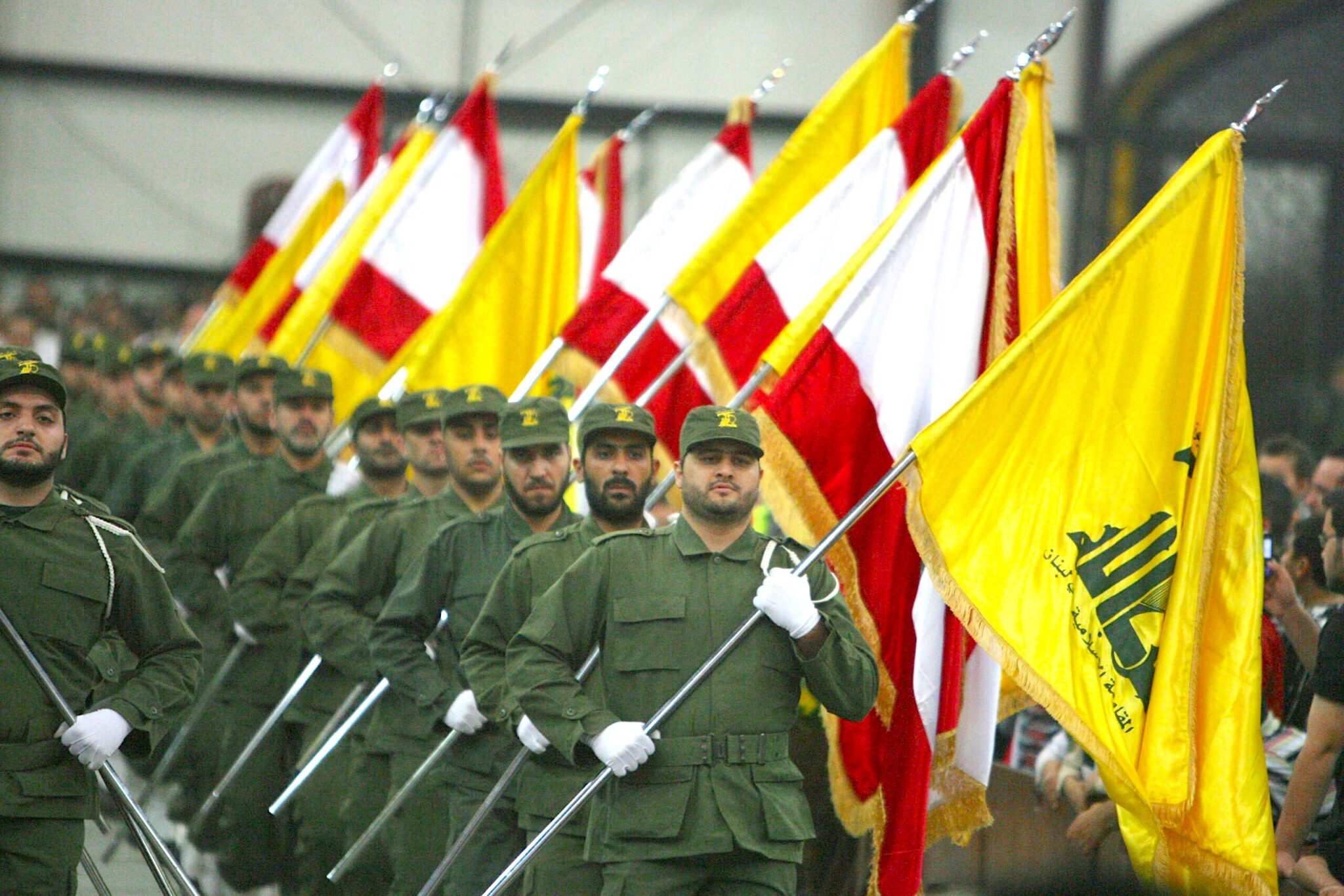
Not achieving an early ceasefire in Gaza risks Hezbollah opening a second front, confrontation with Iran and a world war, writes M.K. Bhadrakumar.
U.S. President Joe Biden is convinced that one of the reasons why Hamas launched its attack on Israel was because of the announcement during the G20 Summit in New Delhi of the India-Middle East-Europe Economic Corridor. But he also admitted that this reading was based purely on his instinct and he did not have any proof for it.
Biden’s motivation in saying so lies in the U.S.’ desperate need to reclaim its leadership role in the Muslim Middle East.
The two most compelling realities rejecting the American leadership are: one, a strong, united, regional solidarity cutting across sectarian divides to seek a settlement on Palestine, such as at no time before, and, two, the Saudi-Iranian rapprochement.
The latest developments involving Hamas and Israel undermined the U.S. efforts to persuade Saudi Arabia to recognise Israel. No doubt, the Saudi stance on the Palestine problem has hardened. Biden reached out to Crown Prince Mohammed bin Salman in an attempt to create as much convergence as possible between Washington and Riyadh.
But the White House readout showed that a critical mass remained elusive; even as the two leaders agreed on generalities, they couldn’t agree on the all-important specific issue of an urgent ceasefire between Israel and Hamas.
This profound disagreement is also reflected in the U.N. Security Council where the United Arab Emirates supported the Russian draft resolution, which called for “an immediate, durable and fully respected humanitarian ceasefire”, but opposed the U.S. draft resolution, which was evasive on ending the fighting and instead harped on Israel’s right to self-defense.
A joint statement signed by the Foreign Ministers of Egypt, Jordan, Bahrain, U.A.E, Saudi Arabia, Oman, Qatar, Kuwait and Morocco called for an immediate ceasefire in Gaza Strip. In an admonition to the U.S. and Israel, the statement stated, “The right to self-defence by the United Nations Charter does not justify blatant violations of humanitarian and international law.”
Looking ahead, the big question is about American intention. Is it muscle-flexing or a hidden plot to create facts on the ground that can be seized as casus belli to launch an offensive against Iran, which has been a longstanding project of the neoconservatives dominating the U.S. foreign policy discourses?
Biden Issues Threat to Iran

Iran’s Supreme Leader Ali Khamenei, sitting under a portrait of his predecessor, Ayatollah Ruhollah Khomeini. (Iranian government)
Biden declared at a press conference in the White House that he had warned Iran’s supreme leader Ayatollah Ali Khamenei that if Tehran continued to “move against” U.S. forces in the region, Washington would respond.
To quote Biden, “My warning to the Ayatollah was that if they continue to move against those troops, we will respond. And he should be prepared. It has nothing to do with Israel.” Biden was referring to growing attacks on American bases in Iraq and Syria.
The political deputy at the Iranian president’s office, Mohammad Jamshidi has since countered Biden’s remark, saying, “The U.S. messages were neither directed to the leader of the Islamic Revolution nor were they anything but requests from the Iranian side. If Biden thinks he has warned Iran, he should ask his team to show him the text of the messages.”
Hours later, when asked to clarify, the U.S. National Security Council spokesman John Kirby parried, “There was a direct message relayed. That’s as far as I’m going to go.” Conceivably, the recent attacks by militant groups in Syria and Iraq pose a headache to Biden in domestic politics.
Reportedly, some two dozen U.S. servicemen have been injured and one military contractor killed so far. There are roughly 2500 American troops in Iraq and some 900 in Syria.
Possibly, Biden was grandstanding. That is not something unusual in U.S.-Iran standoffs. But more likely, the U.S. hopes to nudge Iran to rein in the free-wheeling militia groups in Syria and Iraq from exacerbating the situation.
Iran is on the same page as China and Russia and the Arab states in calling for an immediate ceasefire so that conditions are available for diplomacy to meaningfully tackle the Palestine problem. They stand for a two-state solution. Ironically, the U.S. also claims it supports a two-state solution.
This is what Biden stated at a press conference in the White House, reading out of a prepared text:
“Israel has the right and, I would add, responsibility to respond to the slaughter of their people. And we will ensure Israel has what it needs to defend itself against these terrorists. That’s a guarantee… But that does not lessen the need for — to operate and align with the laws of war for Israeli — it has to do everything in its power — Israel has to do everything in its power, as difficult as it is, to protect innocent civilians … I also want to take a moment to look ahead toward the future that we seek. Israelis and Palestinians equally deserve to live side by side in safety, dignity and peace. And there’s no going back to the status quo as it stood on October 6… It also means that when this crisis is over, there has to be a vision of what comes next. And in our view, it has to be a two-state solution. It means a concentrated effort from all the parties — Israelis, Palestinians, regional partners, global leaders — to put us on a path toward peace.”
US Middle East Influence Diminished
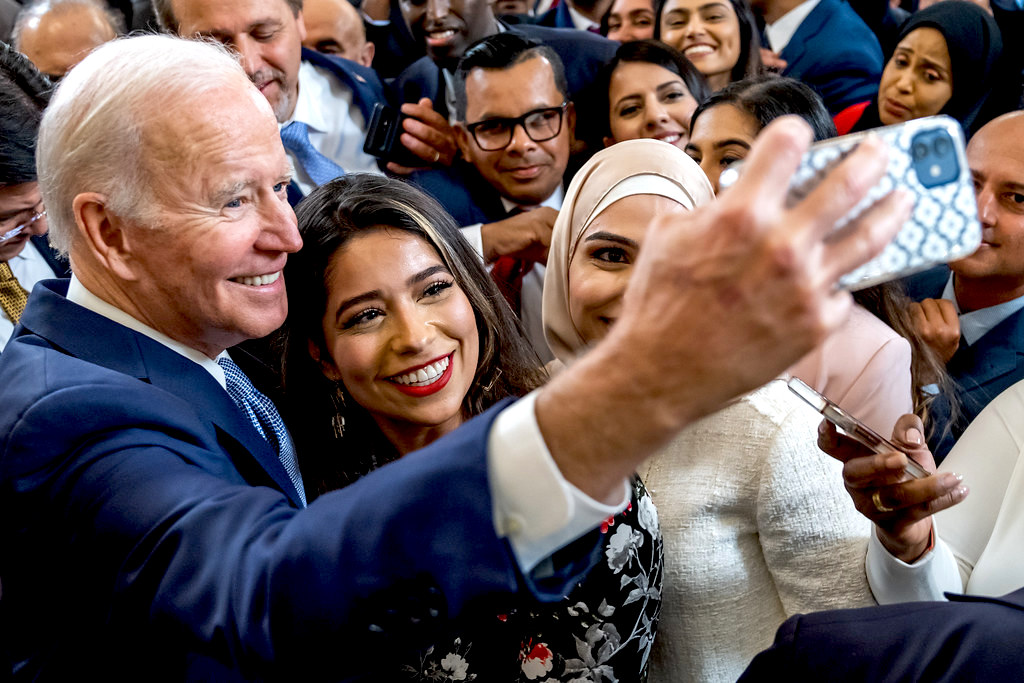
President Joe Biden with guests during Eid celebration reception, May 2, 2022. (White House/Adam Schultz)
Do these words sound as if Biden is preparing for a war with Iran? For the first time, perhaps there is a ray of hope that the U.S. will no longer work around the Palestine problem.
The bottom line, as the deliberations at the U.N. Security Council have also testified, is that all responsible powers understand that the Middle East continues to be the centre of gravity in world politics and a conflagration in the region could easily turn into a world war. And none of the big powers want such an apocalyptic outcome.
That said, while the U.S. still has unrivalled power in the Middle East, its influence has diminished as new realities emerged:
- Israel has grown more powerful militarily and economically vis-a-vis Palestinians, but no longer enjoys regional dominance.
- Saudi Arabia and the UAE, two dominant powers in the Middle East, are increasingly asserting their own interests.
- China, although a relatively new player, is no longer confining itself to economic diplomacy.
- U.S. has lost the capacity to leverage the world oil market, as Russia works closely with Saudi Arabia within the ambit of OPEC+ to calibrate oil production level and prices.
- Consequently, the petrodollar is weakening.
- The Abraham Accords have been shelved practically.
- The Arab-Israeli conflict has assumed new dimensions in the recent years, thanks to the ascendance of the axis of resistance, which require new postures and operational thinking on the part of the U.S.
- Israeli politics moved sharply to the extreme right.
- The global environment is highly complicated; the peace process can no longer be under U.S. mentorship.
Danger of Not Securing Ceasefire
Russia hosted a trilateral meeting in Moscow with Iran’s deputy foreign minister and a Hamas delegation. Later, Russian Deputy Foreign Minister Mikhail Bogdanov, who is also special presidential envoy for the Middle East and Africa, announced that Palestinian leader Mahmoud Abbas “will soon arrive on an official visit” to Moscow for talks with Russian President Vladimir Putin. [The trip, scheduled for Nov. 15, was postponed on Sunday.]
In an all-out war with Iran, the U.S. will take heavy casualties and the state of Israel may face destruction. Indeed, Iran may opt for nuclear deterrent capability. It is a near-certainty that a U.S.-Iran war will turn into a world war. Clearly, war is not an option.
There is high risk, therefore, in the Israelis’ ground invasion of Gaza. If Israel gets bogged down in Gaza, which by no means cannot be ruled out, there is a high possibility that Hezbollah may open a second front. And that, in turn, can trigger a chain reaction that may spin out of control. Herein lies the danger if a ceasefire is not agreed upon early enough in the conflict.