

All Global Research articles can be read in 51 languages by activating the Translate Website button below the author’s name (only available in desktop version).
To receive Global Research’s Daily Newsletter (selected articles), click here.
Click the share button above to email/forward this article to your friends and colleagues. Follow us on Instagram and Twitter and subscribe to our Telegram Channel. Feel free to repost and share widely Global Research articles.
New Year Donation Drive: Global Research Is Committed to the “Unspoken Truth”
***
There is something distinctly revolting and authoritarian about the royal prerogative. It reeks of clandestine assumption, unwarranted self-confidence and, most of all, a blithe indifference to accountability before elected representatives. That prerogative, in other words, is the last reminder of divine right, the fiction that a ruler can have powers vested by an unsubstantiated deity, the invisible God, and a punishing force beyond the reach of human control. It is anathema to democracy, a stain on republican models of government, a joke on any political system that has some claim on representing what might be called the broader citizenry.
On January 11, the UK government, in league with the United States with support from a number of other countries, attacked Houthi positions in Yemen. The decision had been made without recourse to Parliament and justified by Article 51 of the UN Charter as “limited, necessary and proportionate in self-defence”.
In his statement on the attacks, Prime Minister Rishi Sunak pointed to the Houthi’s role in staging “a series of dangerous and destabilising attacks against commercial shipping in the Red Sea, threatening UK and other international ships, causing major disruption to a vital trade route and driving up commodity prices.” He made no mention of the Houthis’ own justification for the attacks as necessary measures to disrupt Israeli shipping and interests in response to their systematic, bloodcurdling razing of Gaza.
Lip service has been paid by the executive within the Westminster system to Parliament’s importance in deciding whether the country commits to military action or not. The stark problem is that the action is always decided upon in advance, and no dissent among parliamentarians will necessarily sway the issue. Motions can be proposed and rejected but remain non-binding on the executive emboldened by the prerogative.
The British decision to commit to the egregious invasion of Iraq in 2003 was already a foregone conclusion, despite preliminary debates in the House of Commons and huge public protests against the measure. On March 18, 2011, the then British Prime Minister David Cameroninformed the House of his intention to attack Libya, leading to a government motion on March 21 that the chamber “supports Her Majesty’s Government […] in the taking of all necessary measures to protect civilians and civilian-protected measures.”
That same year, the then Coalition government in the UK acknowledged that a convention had crystallised in Parliament that the House of Commons should be availed of “an opportunity to debate the matter [of committing troops] and said that it proposed to observe that convention except when there was an emergency and such action would not be appropriate.”
The broadly worded nature of the caveats – in cases of emergency or when it would not be appropriate – have made something of a nonsense of the convention. In April 2016, Secretary for Defence Michael Fallon made much of the “exception”, arguing that it was “important to ensure that this and future Governments can use their judgment about how best to protect the security and interests of the UK.”
Parliament, in short, should be put in its place when necessary. Governments know best when it comes to matters of national security; parliamentarians less so.
“In observing the Convention,” Fallon goes on to explain, “we must ensure that the ability of our Armed Forces is to act quickly and decisively, and to maintain the security of their operations, is not compromised.”
In such cases, matters could be dealt with retrospectively, with the government of the day subsequently informing Parliament after the fact.
An example of this absurd policy was played out in the decision by the UK government in April 2018 to target chemical weapons facilities of Syria’s Assad regime. Hiding behind the weasel word of humanitarianism, the explanation for avoiding Parliament was shoddy and leaden.
“It was necessary,” came the explanation from the PM’s office, “to strike with speed so we could allow our Armed Forces to act decisively, maintain the vital security of their operations, and protect the security and interests of the UK.”
The Yemen strikes eschew humanitarianism (the humanitarian justifications advanced by the Houthis in protecting Palestinian civilians has been rejected), but shipping interests. The Armed forces minister, James Heappey, was satisfied that an exception to the convention in consulting Parliament had presented itself.
“The Prime Minister,” the minister parroted, “needs to make decisions such as these based on the military, strategic and operational requirements – that led to the timing.”
With the horse having bolted merrily out of the stable, Heappey remarked with all due condescension that Parliament would, in time, be able to respond to the decision to strike Yemen. An “opportunity” would be made available “when Parliament returns for these things to be fully discussed and debated.” The sheer redundancy of its role could thereby be affirmed.
Much agitated by this state of affairs, former shadow Chancellor John McDonnell opined that no military action should take place without Parliament’s approval.
“If we have learnt anything in recent years it’s that military intervention in the Middle East always has dangerous & often unforeseen consequences. There is a risk of setting the region alight.”
Liberal Democrat Foreign Affairs spokesperson Layla Moran was of the view that Parliament should not be bypassed in matters of war, yet optingfor the rather fatuous formula arising out of the 2011 convention.
“Rushi Sunak must announce a retrospective vote in the House of Commons on these strikes, and recall Parliament this weekend.”
The use of the royal prerogative in using military force remains one of those British perversions that makes for good common room conversation but offends the sensibilities of the democratically minded elector. A far better practice would be to make the PM of the day accountable to that most essential body of all: Parliament. That same principle would be extended to other constitutional monarchies, which are similarly weighed down by the all too liberal use of the prerogative when shedding blood. If a country’s citizens are to go to war to kill and be killed, surely their elected representatives should have a say in that most vital of decisions?
*
Note to readers: Please click the share button above. Follow us on Instagram and Twitter and subscribe to our Telegram Channel. Feel free to repost and share widely Global Research articles.
Dr. Binoy Kampmark was a Commonwealth Scholar at Selwyn College, Cambridge. He currently lectures at RMIT University. He is a Research Associate of the Centre for Research on Globalization (CRG). Email: [email protected]
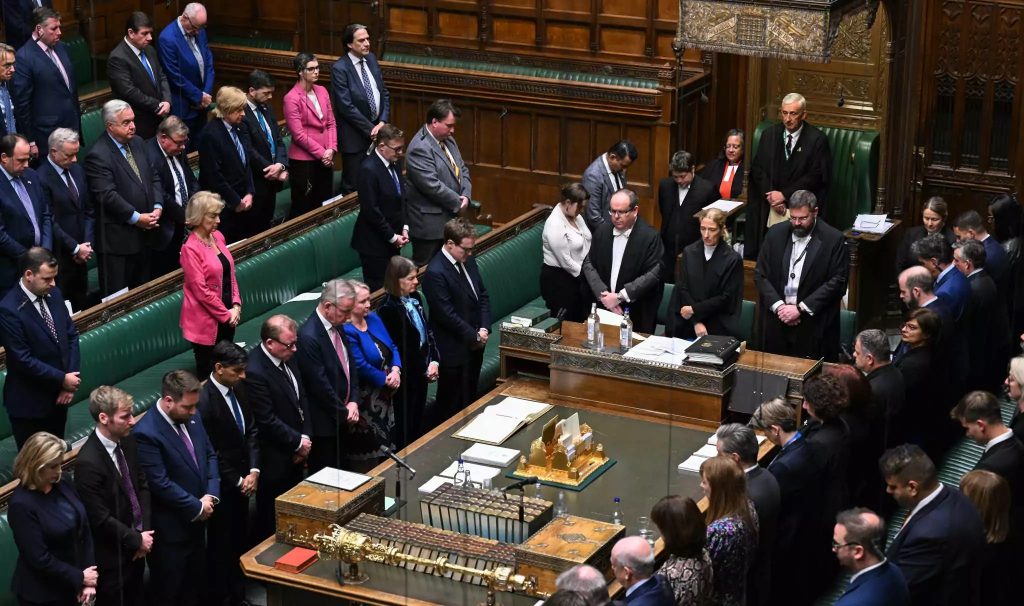
Featured image: (Credit – UK Parliament Flickr)