

The 15th BRICS summit held in Johannesburg in August 2023 marked a significant milestone, particularly for the global south. With a record attendance of 60 countries, the summit witnessed a ‘historic’ expansion of the BRICS alliance. Chinese President Xi Jinping announced the admission of five new member countries: Egypt, Ethiopia, Iran, Saudi Arabia, and the United Arab Emirates (Argentina was also invited but declined).
The expansion didn’t stop there; over 40 countries expressed interest in joining BRICS, with 22 of them, primarily from the global south, submitting formal applications. This surge in interest underscores the growing appeal and relevance of BRICS in shaping global affairs. The growing stature of BRICS reflects an important shift towards multipolarity, challenging traditional power dynamics and fostering a more inclusive approach to global governance and cooperation.
BRICS: Origins, Expansion, and Global Impact
BRICs have an acronymous origin. Eminent economist Terence James O’Neill of Goldman Sachs first coined the acronym BRICs – Brazil, Russia, India, and China – in a paper titled Building Better Global Economic BRICs published in 2001. Two years later another paper titled Dreaming with BRICs: The Path of 2050 argued that the BRICs countries could overtake the largest Western economies by 2039. Noting the economic importance, the leaders of BRIC countries met for the first time on the sidelines of the G8 outreach summit in July 2006. Leaders of all the BRIC nations met formally in Yekaterinburg Russia, in 2009 to give an institutional form to BRICs. In 2011, South Africa joined this grouping as the fifth member forming the BRICS and expanding its horizon from Latin America to Eurasia.
In its second expansion in the 15th summit, 6 countries Saudi Arabia, UAE, Iran, Egypt, Ethiopia, and Argentina formally announced to be part of this grouping. The three main pillars of BRICS are political and security cooperation, economic cooperation, and people-to-people exchanges. BRICS was originally formed for discussion and coordination on economic and trade issues but with the increasing political and economic impact of the members’ state, the group expanded considerably to encompass functional cooperation on a number of global issues. The BRICS has been functioning significantly from the beginning with meetings of member countries at the summit level which is backed by several ministerial meetings and experts. Its major institutions are New Development Bank and Contingent Reserve Arrangement the former provides economic assistance for developmental projects and the latter supports the countries facing balance of payments pressure for the short term.
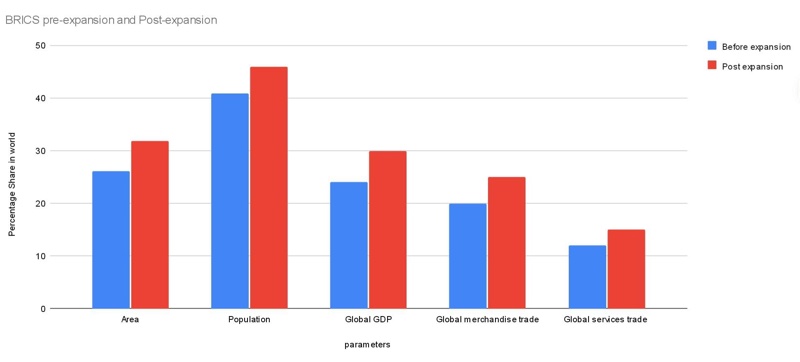
With its increasing outreach as the grouping of developing countries the BRICS gradually became a center stage for the global South. In this article, we make an analysis of the role of BRICS as an organization of the global south.
BRICS and the Quest for a Just Multilateral World
Nobody can deny that today’s world is Multipolar and it needs a just multilateral world. Democratic deficits in the institution of global governance and Lack of substantive inclusion and representation of emerging and developing economies in the existing multilateral political and financial institutions force them to look towards institutions that fulfill their shared interest and needs. At the Johannesburg summit of BRICS, the UN Secretary-General Antonio Guterres said that “today’s global governance structure reflects yesterday’s world. They were largely created in the aftermath of World War II when many African countries were still ruled by colonial powers and were not even at the table”. Deep shortcomings in the institution of Global architecture put a question mark on its legitimacy and weaken the public perceptions of Multilateralism.
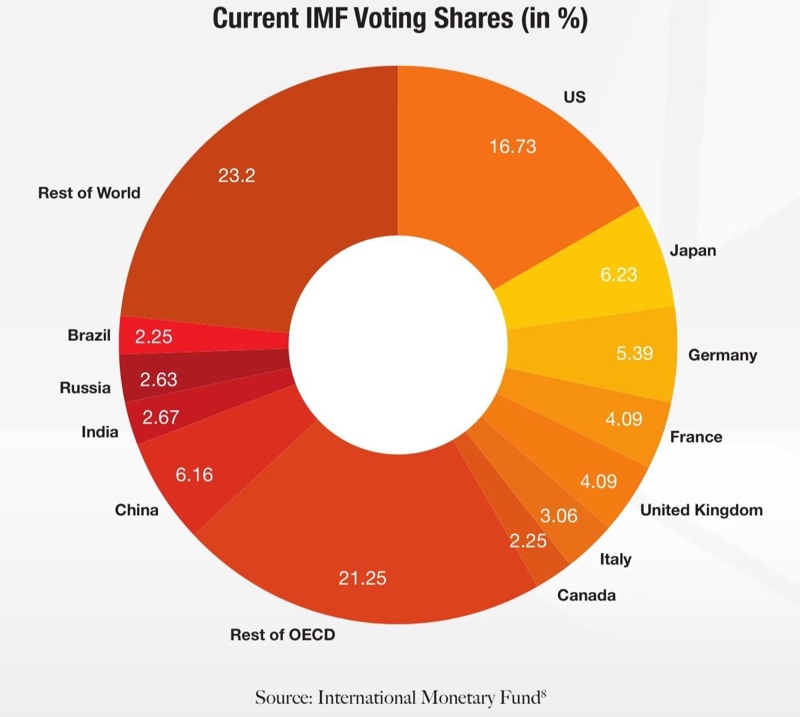
We noticed that the IMF quota and World Bank reforms which have been in demand for a long time were implemented in 2016 but they are still insufficient in granting the just influence of the developing nations in the decision-making power of these institutions. Though these reforms in the IMF give greater influence to Japan, China, India, Brazil, and Russia in quota and vote-sharing, the USA still maintains its share above 15% and unilaterally exercises its veto powers according to their interest. On similar lines, the World Bank redistributed its voting Power to China and India but it lacks any window for the other developing nations. In the World Bank also, the USA has a dominant hand in voting power with 15.85 percent.
Despite the WTO’s undeniable success, a changing international economic environment creates a series of significant challenges for the organization. Global trade landscape has changed significantly since the WTO was set up in 1995, but many of today’s trade issues are not adequately addressed by WTO rules. USA blockage of appointments to the Appellate Body, the body that enables member states to act against the violations of global trade law, paralyzed the Dispute Settlement Mechanism of WTO. The failure of rule-based international trading orders results in a Lack of transparency, distortionary Subsidies, Tariffs, and Non-tariff Barriers.
The role and activities of the World Health Organization (WHO), which has historically played an important role in protecting public health, have come under intense scrutiny during the pandemic. The ongoing challenges faced by poor and developing countries in accessing medicines, treatments and vaccines are stark reminders of existing inequalities. Outbreak reporting processes and frameworks need to be reviewed to improve the effectiveness of early response strategies. The crisis has also refocused WHO’s funding mechanisms, which allow for greater flexibility when needed.
Against the background of repeated calls for reform of the WHO, all member states must be included in all budgetary and financial discussions. Perceiving their marginalization in these western dominated institutions many countries from the global south show their eagerness/willingness to join BRICS to strengthen their voice in decision-making. In 2009, the first BRICS leaders’ summit also declared “We express our strong commitment to multilateral diplomacy with the United Nations playing the central role in dealing with global challenges and threats. We underline our support for a more democratic and just multipolar world order based on international law, equality, mutual respect, cooperation, coordinated action, and collective decision-making of all states.” The inclusion of the African Union (AU) in G20 is the manifestation of the commitment of the BRICS leaders.
With its institutions like NDB and Contingent Reserve Arrangement which have been successfully developing as an alternative to existing financial institutions. NDB aims to mobilize resources for infrastructure and sustainable development projects in BRICS countries and other emerging economies and developing countries to complement the existing efforts of multilateral and regional financial institutions for global growth and development. NDB under its Emergency Assistance Facility provides loans to the member countries to finance direct expenses to provide support to governmental measures. NDB has so far approved 70 infrastructure and sustainable development projects worth USD 25.07 billion across all the member countries in the past five years. This includes 18 projects in India worth USD 6.9 billion. NDB also funds projects in areas such as sustainable infrastructure, clean energy, social safety, public health, education, water, sanitation and flood protection, renewable and green energy, transport, infrastructure, irrigation, agriculture, smart cities, etc.
In July 2014, Nobel Prize-winning economist Joseph Stiglitz said the NDB marks a “fundamental change in global economic and political power”. Unlike the unequal quota and vote sharing in the Bretton Woods institutions like IMF and World Bank, the equal voting rights in the New Development Bank play an important role in the development of the countries of the Global South. BRICS Contingent Reserve Arrangement (CRA) is a framework for the provision of support through liquidity and precautionary instruments in response to actual or potential short-term balance of payments pressures and to protect against global liquidity pressures.
BRICS: Evolving from Trade to Global Security
In the early years of its formation BRICS primarily focused on trade and economic issues, however, the Conflicts and hostilities around the world, as well as challenges like terrorism, extremism, piracy, and cybercrime, have regularly been noted by the annual summits of BRICS. Since the inaugural Yekaterinburg Declaration in 2009, terrorism has received the most attention among these issues and has received the most discussion at BRICS meetings. The group recommended a comprehensive approach to terrorism in all its forms, including violent extremism, radicalization, terrorist financing and recruitment, illegal drug trafficking, and money flows. Below you can find a comprehensive representation of the evolution of BRICS agenda on global security.
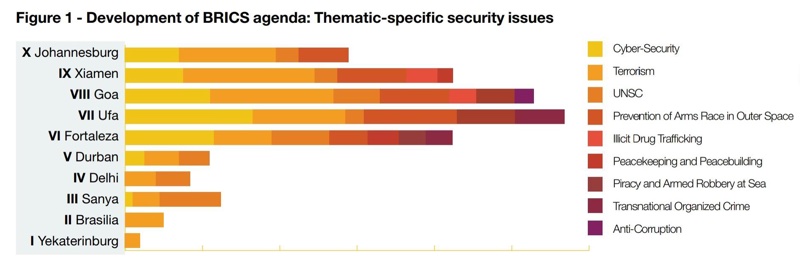
The BRICS have deliberately created concepts for institutional and legal structures to fight and counter-terrorism over the last 15 years. It has negotiated for the Comprehensive Convention on International Terrorism (CCIT) at the United Nations (UN), in addition to supporting the Financial Action Task Force (FATF) and comparable regional organizations. A BRICS Council on Anti-Money Laundering and Countering the Financing of Terrorism was established within the FATF in 2015.
In 2016, BRICS established its first cooperation mechanism, the Counter-Terrorism Working Group (CTWG), to identify global and regional issues and strengthen the BRICS Counter-Terrorism Coordination Strategy. The approach of the BRICS countries also stated that the fight against terrorism and the reformation of global governance institutions are not separate from each other.
Therefore, the democratization of decision-making and representation in global political and financial institutions are important steps. The BRICS partners have always reminded and appealed to the international community that global decision-making should reflect the realities of the contemporary world. Since the first summit in 2009, BRICS statements have emphasized the central role of the UN and the UN Charter in coordinating multilateral counter-terrorism efforts. All BRICS declarations called for a multilateral approach to combating international terrorism and strengthening national and international laws.
Though the BRICS nations are pushing for Multilateralism in counter-terrorism efforts, Russia and China being the permanent members of the United Nations Security Council are very apathetic towards reforming the UNSC structure and mechanisms. Rest of the BRICS countries like Brazil, India, and South Africa always demand reforming the existing UNSC structure according to the changing world order. Lack of practical cooperation within the BRICS weakens its potential to resolve international security issues.
BRICS Commitment to Climate Change and Sustainable Development
Since 2009, the BRICS countries have emphasized their commitment to combat climate change. In the declaration of 2009, the BRICS countries announced their willingness to conduct a constructive dialogue on the issue of combating climate change, based on the principle of common but differentiated responsibility, taking into account the need to combine climate protection measures with activities aimed at fulfilling their tasks of socio-economic development.
The group adopted the BRICS Leaders’ Xiamen Declaration in September 2017 and reaffirmed its commitment to fully implement the 2030 Agenda for Sustainable Development. They pledged to strengthen BRICS cooperation on climate change and expand green finance. The BRICS countries recognize that they make up an important part of the world’s population, land, and natural resources, and their choices have global significance. Acknowledging this, the BRICS countries have implemented several projects aimed at promoting cooperation on climate change and sustainable development.
For example, the Youth Energy Agency encourages young scientists from BRICS countries to conduct research, promote public awareness, and expand the UN 2030 Agenda.This agency also launched the BRICS Sustainable Ideas Bank platform, which aims to systematize and collect public input on SDG-related ideas relevant to the BRICS countries, monitoring the dynamics of SDG-oriented proposals, and strengthening SDG-friendly proposals and participation in all BRICS countries.
The BRICS is a participant in global climate governance and a builder of mechanisms for it. BRICS always reaffirms the role of the United Nations Framework Convention on Climate Change (Convention) and its Paris Agreement as the fundamental legal basis and the main channel for international cooperation on addressing climate change and is committed to promoting the full and effective implementation of the Convention and its Paris Agreement. (Joint Statement issued at the BRICS High-level Meeting on Climate Change).
BRICS also supports multilateral climate finance mechanisms. The current international financing structure for climate change comprises three parts bilateral assistance (developed countries directly assisting developing ones); multilateral assistance (through institutions like the Climate Investment Fund and World Bank); and the mechanism model created by the United Nations Framework Convention on Climate Change. Compared to bilateral donors, multilateral institutions can assist many countries and projects. A multilateral system of aid also tends to open another channel of support for developing countries. These countries should not have to rely only on developed countries for climate-related assistance and finance.
Recently, Indian Prime Minister Narendra Modi invited the participating countries of the 2023 BRICS Johannesburg Summit for international initiatives such as the International Solar Alliance; One Sun, One World, One Grid; Coalition for Disaster Resilient Infrastructure; One Earth One Health and Big Cat Alliance.
Conclusion
The fragmentation and weakening of the global governance institutional structure due to deglobalization, protectionism, and unjust multilateralism. It underscores the importance of the approaches taken by certain BRICS countries to promote horizontal partnerships and mutual benefit, bridging longstanding gaps and providing hope for engagement in global governance processes. The proactive role of BRICS countries in global governance is seen as an opportunity to enhance their contributions to support the development needs of the global South. Many countries from the global South have increasingly turned to BRICS nations to navigate an institutional architecture that has historically been inadequate and imposing complex conditionalities that hinder their natural progression. The article emphasizes that addressing the trend of non-participatory decision-making and reform in global institutions can only be achieved through deeper partnerships and South-South cooperation.
About the authors:
- Balinder Singh: Research Scholar and Academic. Ph.D. in Political Science, Central University of Himachal Pradesh, Dharamshala, India. Dr. Singh has actively participated in numerous national and international conferences and has published over 25 research articles in esteemed international journals.
- Prof. (Dr.) Jagmeet Bawa: Professor and Head, Department of Political Science, Central University of Himachal Pradesh, Dharamshala, India. Dr. Bawa brings with him a rich experience of 15 years in teaching and research. His expertise lies in the domains of Indian Political System and Central Asian Politics. Prior to his current position, he taught for a decade at I K Gujral Punjab Technical University, Jalandhar, India. Throughout his academic journey, he has guided ten students toward the successful completion of their Ph.D. degrees. Additionally, Dr. Bawa’s scholarly contributions extend to the realm of publications, with five books authored and over 30 research papers penned. His pursuit of academic excellence has taken him across various countries, where he has engaged in academic and research activities. Presently, his focus lies on Central Asian Politics, with four students currently pursuing their doctoral degrees under his guidance on this very subject.
- Anup Trivedi: Central University of Himachal Pradesh, Dharamshala, India.