

Policy that prohibits partnerships between state universities and ‘countries of concern’, including China, will erode competitiveness, faculty members say.
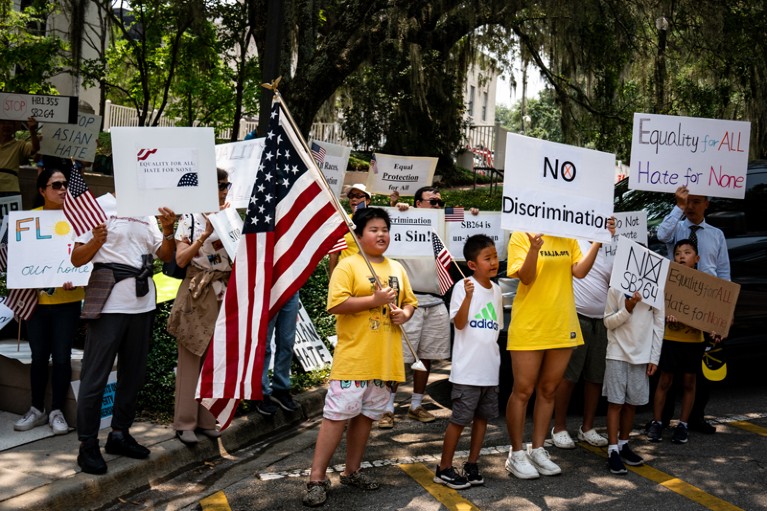
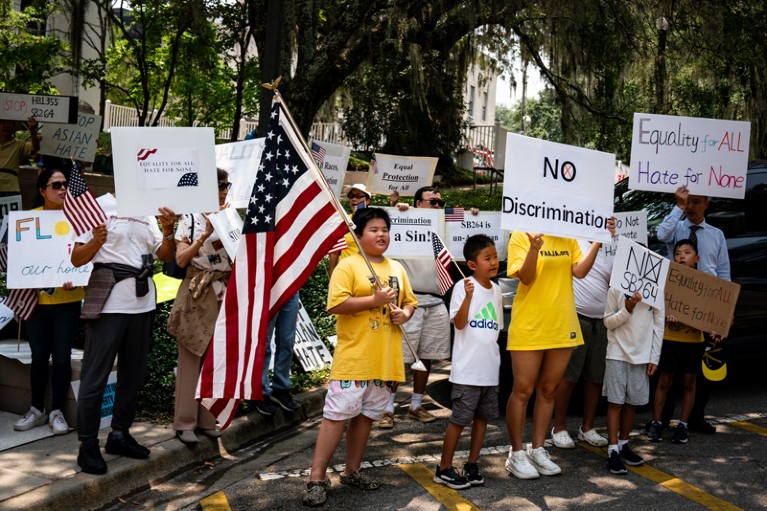
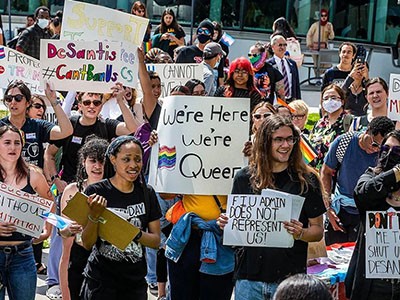
Families protest against the passage of Florida law SB 846, which restricts state universities from hiring researchers from China and six other countries.Credit: Erich Martin/ACLU
Public institutions in Florida are struggling to adapt after a state law quashed the recruitment of graduate students, postdocs and staff members from China, Russia, Iran and other countries labelled as of concern. The law, passed unanimously by the state’s legislature in May 2023 as a way of addressing foreign interference in academia, has prompted fierce backlash from university faculty members. They say that it will affect hundreds of early-career researchers and that it risks driving talent away from the state.
“This is exclusion. This is discrimination,” says Zhengfei Guan, a food and resource economist at the University of Florida (UF) in Gainesville. “It’s not just about dealing with interference from certain governments, it’s prohibiting individuals from coming to America. There are no other words for that.”
The Florida law, called SB 846, bars the state’s 12 public universities from taking money from or forming “partnerships” with entities in a “country of concern”, named as China, Russia, Cuba, Iran, North Korea, Syria and Venezuela. Although it doesn’t affect undergraduate admissions or individuals already living in the United States, the law places restrictions on collaborations with colleagues in these countries and on the hiring of graduate students, postdocs and research staff from abroad. Guan says that candidates from China and Iran in particular make up a big proportion of the UF applicant pool. Currently, several hundred UF graduate students and postdocs hail from the seven countries.
Why it would be a dangerous folly to end US–China science pact
SB 846 follows on the heels of other US legislation and policies aimed at curbing foreign influence in research and industry. The China Initiative, launched in 2018, sought to prosecute researchers with undisclosed ties to the Chinese Communist Party, but netted very few arrests and was discontinued in 2022 after allegations that it spread anti-Asian attitudes.
In Florida, universities are required to review the proposed employment of any researcher with foreign ties — even US citizens who are living abroad or who have previously received training or been employed outside the country. Candidates who fail this ‘risk-based’ assessment must then have their identity passed to a law-enforcement agency dictated by the governor. The same law also mandates that universities monitor employment-related travel to foreign countries for professional activities such as conferences.
Rory Truex, an international-affairs researcher at Princeton University in New Jersey, says that blanket policies such as these have typically been ineffectual at clamping down on intellectual theft, because so much US research is openly shared. Instead, Truex says that SB 846 and its predecessors reflect a growing paranoia about foreign espionage that has damaged the country’s academic competitiveness by alienating talented early-career researchers. “Chinese universities are basically all public institutions, and anything public in China also means a high degree of control by the Chinese Communist Party,” he says. “But that interconnectedness does not mean that faculty and students [from those universities] cannot be trusted.”
Early days
SB 846 went into effect last July, just before the beginning of the academic-year hiring cycle. Already, some researchers have reported disruptions. Guan planned to extend an offer to a postdoc from China in August, but had to seek approval from UF. The institution, in turn, reached out to the state’s board of governors, which oversees all Florida public universities. At first, Guan says, he was told that the process would take weeks, but as it stretched into months, he had to defer the postdoc’s start date to October, then November. By December, the applicant said that they were aware of the law and had accepted a position in another state.
“I was desperate to get this brilliant young man into the research programme, and I was telling the university that it would be a blessing for us,” Guan says. “This law is creating a very hostile environment — it’s treating students and faculty from these countries like criminals — and this will have a very negative effect on the academic environment in this country.”
Why the US border remains ‘a place of terror’ for Chinese researchers
Scientists are also concerned about their federal research grants, many of which ban discrimination on the basis of race, ethnicity or nation of origin. A US National Science Foundation (NSF) spokesperson says that the agency cannot comment on whether it has entered into any conversations with the state university system or the board of governors. However, the NSF expects all awardee organizations to adhere to the Civil Rights Act of 1964, including for “NSF-funded awards and the admission process for educational and research programs within awardee organizations”. Compliance reviews are carried out by the NSF in response to complaints, but the agency did not respond to questions about whether any such complaints had yet been raised.
Not everyone is feeling pinched by the news. At UF’s College of Medicine, also in Gainesville, only US citizens or permanent residents can be admitted to the MD programme. International PhD students can be admitted as students, but not paid as employees from a grant. This means that hiring practices haven’t changed much for UF cancer-cell biologist Daiqing Liao. He hired a research assistant from China without issue just before the law went into effect; he says the assistant plans to apply to a PhD programme at the university but might face hurdles. If hiring becomes more challenging, Liao will probably shift to hiring staff from other countries, particularly India. “So far, though, I haven’t noticed very much, and so it’s hard to know how this will impact my lab long-term,” he says.
How universities are adapting
Last December, members of the UF Florida Chinese Faculty Association launched a petition urging “the timely development of clear guidance regarding the hiring procedures”, and asking UF president Ben Sasse to support open hiring practices. As of late January, more than 370 faculty members have signed it, noting that “failure to act swiftly may result in the loss of exceptional students to other universities”.
Both Guan and Liao say that they have yet to receive clear guidance from UF on how the law will be implemented. Christina Ciocca Eller, a sociologist at Harvard University in Cambridge, Massachusetts, who previously co-chaired a committee on research security for the US Office of Science and Technology Policy, says that administrators are probably struggling to adapt. “Universities are very torn in their responsibilities — they don’t want to break laws, but at the same time, they have responsibilities to their [researchers] to give them the capacity to pursue the scientific enterprise,” she says. “At the very least, the responsibility is to make clear what the policy is.”
Stacey Patterson, vice-president for research at Florida State University in Tallahassee, says that the school has established a foreign-influence task force to lead its implementation process, and is working on a set of frequently asked questions about the regulation. It is also formulating a process for seeking pre-approval from the board of governors, which can grant exceptions to the law.
Academics fight moves to defund diversity programmes at US universities
Steve Orlando, associate vice-president for communications at UF, says that his university will not be establishing an analogous group to assess the legislation, and is instead adopting the eight-step approval process laid out by the board of governors. A flowchart of the process, which Orlando says was “communicated clearly to deans and centre directors”, outlines how researchers will need to consult with their university’s general counsel and receive approval from their institution’s board of trustees before bringing a petition before the state board. The state board did not respond to questions about whether its members have yet considered a request.
According to Ciocca Eller, this case-by-case assessment of petitions will place an enormous strain on time and resources, requiring new offices to process requests and creating hiring log-jams. “It’s going to be really hard for these institutions to prioritize this, which will lead to more backlog of academics [not] being able to pursue their research because they’re waiting for a directive from the board.”
Already, Florida is experiencing a brain drain as researchers move to states with less-restrictive policies — a trend felt especially keenly among Chinese and Chinese American scientists. A 2023 survey1 of more than 1,300 tenured or tenure-track scientists of Chinese descent at US universities revealed widespread feelings of fear and anxiety regarding their future in the United States.
“Many are saying that we’re simply better off voting with our feet” and moving elsewhere, Guan says. “I have the same sentiment, but there’s still injustice here, so I’ve decided to stay and fight.”
doi: https://doi.org/10.1038/d41586-024-00554-2