

Protests break out in parts of the country. Police presence beefed up. Critics of the law call its timing cynical.

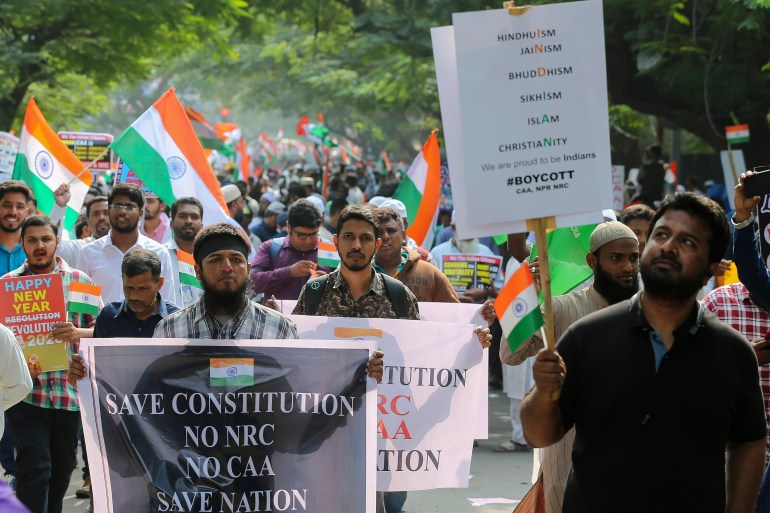
Indians hold placards as they march during a protest against a new citizenship law that opponents say threatens India’s secular identity in Hyderabad, India, Saturday, Jan. 4, 2020. The new citizenship law and a proposed National Register of Citizens have brought thousands of protesters out in the streets in many cities and towns since Parliament approved the measure on Dec. 11, leaving at least 23 dead in clashes between security forces and the protesters. (AP Photo/Mahesh Kumar A.)
New Delhi, India — Protests have erupted in parts of India over the Narendra Modi government’s implementation of a controversial citizenship law ahead of national elections, as security forces rushed to areas of the national capital that had previously been epicentres of large demonstrations against the legislation.
The notification of the Citizenship (Amendment) Act (CAA) on Monday introduces the country’s first religion-based citizenship test after decades of a constitutional setup that swears — at least officially — by secularism. Critics say the law discriminates against Muslim asylum seekers.
The amendment expedites citizenship for refugees from India’s neighbouring nations who are Hindu, Sikh, Christian or from other religious minorities — but not if they are Muslim. As a result, the benefits do not extend to the Rohingya from Myanmar, persecuted Ahmadiyya from Pakistan, or the Hazara from Afghanistan, for instance.
“The CAA has always been about creating two tiers of citizenships in India: non-Muslims and Muslims,” said Yogendra Yadav, a political scientist and activist who was closely associated with the anti-CAA protests. “It is voter polarisation [by the BJP] before elections but are we surprised?”
Parliament passed the CAA in 2019, but Modi’s Bharatiya Janata Party (BJP) government has since delayed its implementation. Months-long protests against the law brought parts of New Delhi to a standstill, as the capital was hit by sectarian violence in early 2020. More than 100 people were killed in the violence across the country, mostly Muslims.
On Monday, after the government announced the notification of the law, protests broke out at the Jamia Millia Islamia university in New Delhi, students told Al Jazeera. Soon, police forces arrived as tensions rose.
Police were also rushed to northeast Delhi, which had witnessed some of the worst violence after the passage of the 2019 law. Security forces also conducted flag marches in areas near Shaheen Bagh, which became a hub of protests against the CAA in 2019 and 2020.
Separately, in the northeastern state of Assam, activists from several organisations, including the All Assam Students’ Union (AASU), burned copies of the law and called for a statewide shutdown on Tuesday. Similar protests are also lined up in other regional states, including Meghalaya and Tripura, by various student groups. Many of these groups are critical of the law not because of allegations that it discriminates against Muslims — but because they oppose any influx of refugees from other nations.
‘Timed to polarise’
Lawyers and critics of the government have also questioned the timing of the implementation of the law — on the eve of Ramadan, which began in India on Tuesday, and weeks before national elections, which are expected to be held in April and May.
Different groups have filed more than 200 petitions challenging the law that are still pending before courts.
“The CAA is unconstitutional and discriminatory on several grounds, including exclusion based on religion,” said Prashant Bhushan, a senior Supreme Court lawyer. “The timing of the notification is meant to polarise the electorate upon the Hindu-Muslim divide.”
The Modi government has previously linked the CAA to another controversial initiative, the proposed National Register of Citizens (NRC) that could lead to the deportation of millions who have lived in India for generations but do not have identity papers proving the legal status of their ancestors. Muslim groups and rights activists say the combination of the CAA and the NRC could be used to target members of India’s 200 million-strong Muslim population. “You will use NRC to exclude people, then use CAA to only selectively include people,” said Bhushan.
Asaduddin Owaisi, a member of parliament from Hyderabad and leader of the opposition All India Majlis-e-Ittehadul Muslimeen party, said the “divisive” law is “meant to target only Muslims”, adding that people will have no choice but to oppose it again.
The Indian government has repeatedly denied these accusations, saying the CAA is meant to grant citizenship, not to take it away from anyone. It called the earlier protests politically motivated.
‘Divide and distract’
The introduction of the CAA law comes at a time when the Modi government is facing scrutiny over an electoral bonds scheme that allowed corporate groups to donate millions of dollars to political parties without any transparency over who was giving whom how much. In February, India’s Supreme Court struck down the scheme, calling it unconstitutional, and ordering the public sector State Bank of India (SBI) — which implemented the electoral bonds initiative — to reveal details of donors.
The top court told the SBI to release the details by Tuesday, in a setback for the government, which had attempted to shield that information from public scrutiny. Hours later, the Modi administration announced the CAA implementation.
“It is a diabolic attempt to divide and distract,” said Yadav. “Divide along the communal lines and distract from the issue of electoral bonds.”
The publication of the notification on Monday evening “appears to be an attempt to manage the headlines after the Supreme Court’s severe strictures on the Electoral Bonds Scandal”, said Jairam Ramesh, a senior leader of the opposition Congress party.
For millions of Muslims in India, though, the moment brings back memories of a tumultuous period four years ago.
‘Fight for identity’
Ahad was 18 when he skipped his college in New Delhi to join hundreds of women in Shaheen Bagh, a Muslim working-class neighbourhood, to block a crucial road between the capital and Noida, a suburb, as part of anti-CAA protests. “It was a fight for our identity, our existence,” recalled Ahad, who requested he only be identified by his first name.
Four years later, the law was notified at a time when he and his friends were busy with Ramadan preparations. “The government timed it like an ace,” he said, heading out of home for tarawih prayers. “Everyone around us is busy planning for Ramadan, and the news came out of nowhere.”
After the violence broke out in New Delhi in February 2020, the government clamped down on the activists and student leaders organising protests. Nearly 750 cases were filed in connection with the violence – mostly notably “FIR 59”, which features 18 people accused of conspiring to instigate the violence and charged under sections of the law that relate to terrorism. The accused include student leaders Umar Khalid, Sharjeel Imam and Gulfisha Fatima.
For Safoora Zargar, one of the co-accused in FIR 59, the implementation of CAA marks a “dark day for Indian democracy”.
“The anti-CAA protests had given Muslims the voice and space that we needed and contributed significantly in shaping many important narratives with rest to citizenship in the country.”
Zargar was three months pregnant when she was arrested by the police and imprisoned in New Delhi’s overcrowded Tihar Central Jail in the middle of the pandemic. She was released more than two months later on orders of the Delhi High Court on humanitarian grounds.
Yadav, who was also part of the demonstrations in part of the country, said the Shaheen Bagh blockade came under the spotlight but the movement at large “was a glorious chapter in the history of India, where citizens stood up against an attempt to divide the country”.
“More than anti-CAA protest, it was an Equal Citizenship Movement,” he said, adding that the protests did not fail. “Historians will look at independent India and they would remember anti-CAA as we today remember the first revolt of 1857 that led India’s independence movement.”
Nadeem Khan, civil rights activist and co-founder of a campaign called United Against Hate, said the CAA seeks to fundamentally alter the character of the Indian republic. “We believe that the CAA is a dishonest attempt on the part of the government to further its Hindutva agenda under the garb of providing assistance to refugees.” Hindutva is the Hindu majoritarian political ideology of the BJP and many of its allied groups.
Still, say activists who opposed the CAA in 2019, they will continue to fight against what they argue are discriminatory policies — even with friends and colleagues still behind bars.
“I can say for sure that this does not break the spirit or resolve [of the political prisoners],” said Zargar. “The anti-CAA movement is not just about one law, it is about justice and equality for all. No citizen of this country should settle for anything less.”