


There are prospects for and against full-scale war breaking out. Here are some factors to consider.

Hezbollah supporters attend a speech by its leader Hassan Nasrallah in Beirut, Nov. 3, 2023. (Fars Media Corporation, Wikimedia Commons, CC BY 4.0)
There is a lot of talk in the East and West about the prospects of war between Lebanon and Israel. The chatter may reduce the possibility of full-scale war erupting because Israel usually favors taking Arabs by surprise.
“Pre-emptive” wars and strikes, and taking the military initiative, are central to Israel’s military doctrine. Israel would have entered the war, had it wanted, back on Oct. 7 because at that point, Hezbollah was not prepared for conflict, despite its solidarity with Palestine. Hezbollah did not have advance warning from Hamas about the Aqsa Deluge. The party was as surprised as other Arabs by the Hamas attack.
It’s a possible point of discussion whether it would have helped Hamas to inform Hezbollah in advance about the general outline of the operation, or even just the timing of it.
But Yahya Sinwar, the Hamas commander, was careful about the security of his operation and the safety of his fighters and cadres. The man who studied the enemy for years in prison learned the art of pre-emption and surprise. But the Arabs have never perfected it except in the October War (which Anwar Sadat, Egypt’s president, transformed from an early victory into a certain defeat).
What Are the Prospects for War?
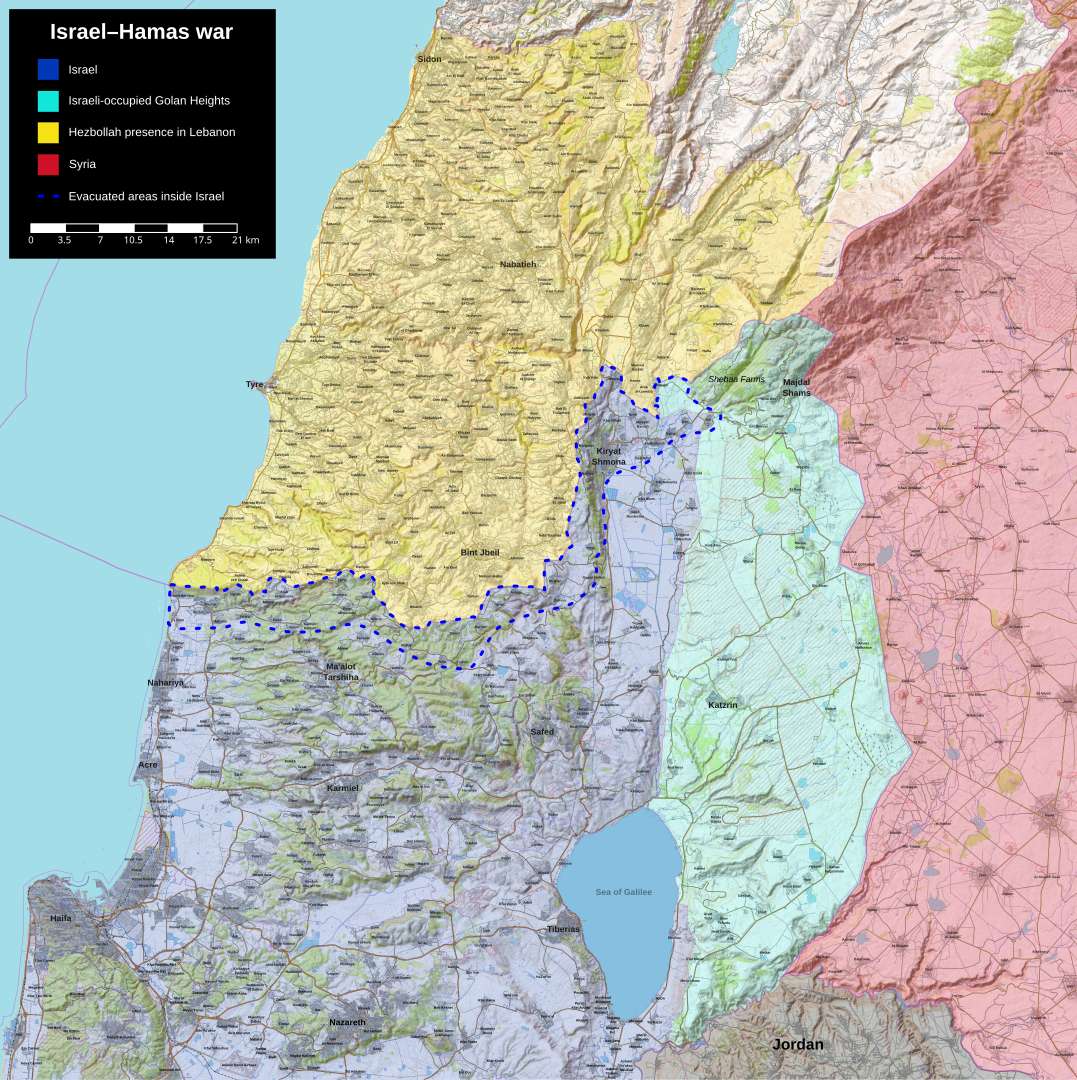
Map showing the Lebanese, Syrian, and Northern Israel theater of the 2023 Israel-Hamas war. (Veggies and Ecrusized, Wikimedia Commons, CC BY-SA 4.0)
1) Israel needs desperately to achieve a military victory, something that has eluded it in Gaza; Israel’s military prestige vis-a-vis the Arabs needs an immediate rescue.
2) Hezbollah started the conflict and hasn’t stopped fighting regardless of the pressure and Israeli aggression, and Israel may decide it needs to deter the party once and for all.
3) There is a wide Lebanese opposition camp (sponsored by Saudi Arabia and the U.A.E.) that is willing to indirectly support Israel and it is participating, or contributing daily, to the Israeli propaganda war effort, just as there was a wide Lebanese camp (comprised of mostly Christians and Shiites) behind Israel back in 1982 against the PLO.
4) The Biden administration is absolute in its total support for Israel and its aggression. It is not certain that Israel violated red lines set by Joe Biden; it is more likely that there were no real red lines to start with. And Israeli Prime Minister Benjamin Netanyahu may want to exploit the U.S. election year to achieve a victory against Hezbollah — a victory that Israel could not achieve back in 2006.

Biden with Netanyahu in Tel Aviv on Oct. 18, 2023. (The White House, Public domain)
In the U.S., the presidential competition between Biden and Donald Trump is such that it will prevent the Democratic incumbent from putting any restraints or constraints on Israeli aggression — assuming he even wanted that, given that he is the first American president to self- identify as a Zionist.
5) Factional infighting in Israel could put aside the rational calculations of cost-benefit analysis. The ruling elite in Israel may drift towards the irrational option.
6) The status of Netanyahu, politically and judicially, is very critical and he will face a big crisis as soon as the war ends for having the Oct. 7 Aqsa Deluge occur on his watch.
7) Israel does not have a path to end the war in Gaza and hopes war with Lebanon may help it somehow.
What Are the Prospects of No War?
1) Israel’s military performance has not been impressive at all. Its forces have committed massacres and crimes of genocide but there are no military victories to speak of and no dismantling of Hamas’ structure. Israel promised early in the July war of 2006 to dismantle Hezbollah and to eliminate its missile arsenal completely. Whenever Israel declared its end was accomplished, Hezbollah would surprise it with a fresh volley of missile attacks.
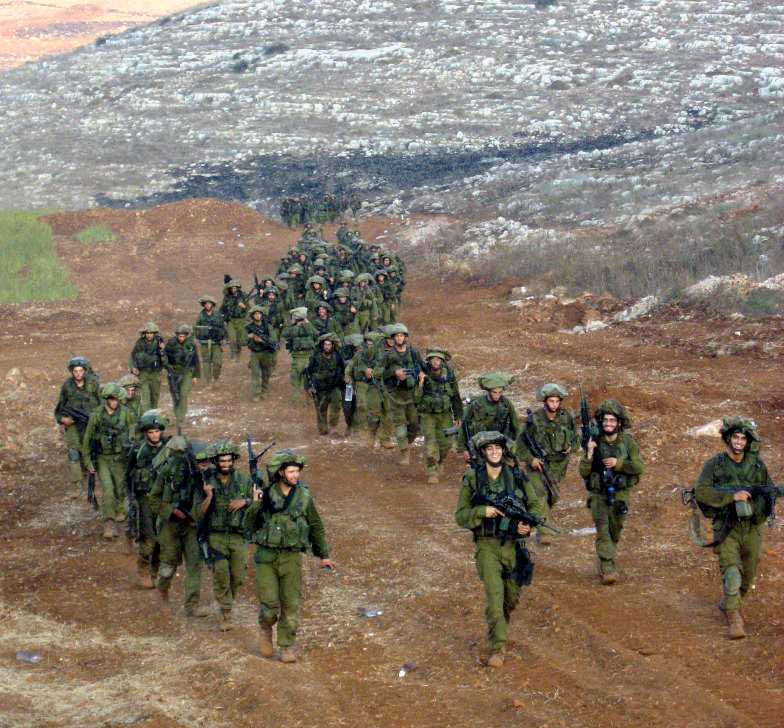
Israeli soldiers leaving Lebanon, Aug. 1, 2006. (Amnon Tsur Pardes Hana, CC BY-SA 3.0, Wikimedia Commons)
If Israel is faltering in Gaza, it’s unlikely that its performance in Lebanon will be better, especially against the most powerful element of the axis of resistance in the Middle East. This element has become stronger than all other Arab armies and has accumulated fighting abilities in the civil war in Syria.
The Israeli army, on the other hand, has not engaged in actual military combat against an experienced army in many years. Israel tried to advance into the territory of South Lebanon in the July War in 2006 but its advance was prevented by fierce resistance. Israel would enter war when it can guarantee a decisive victory; it won’t accept anything less than that.
It entered the July War on the assumption that it would be a replica of the invasion of 1982, when it exploited the pretext of an assassination attempt on the Israeli ambassador in London to finish off the PLO. Indeed, Israel decisively and quickly defeated its enemy, and the PLO and the Lebanese National Movement were largely eliminated as a military threat to Israel, despite the rise of a leftist and Islamist resistance movement within the first year.
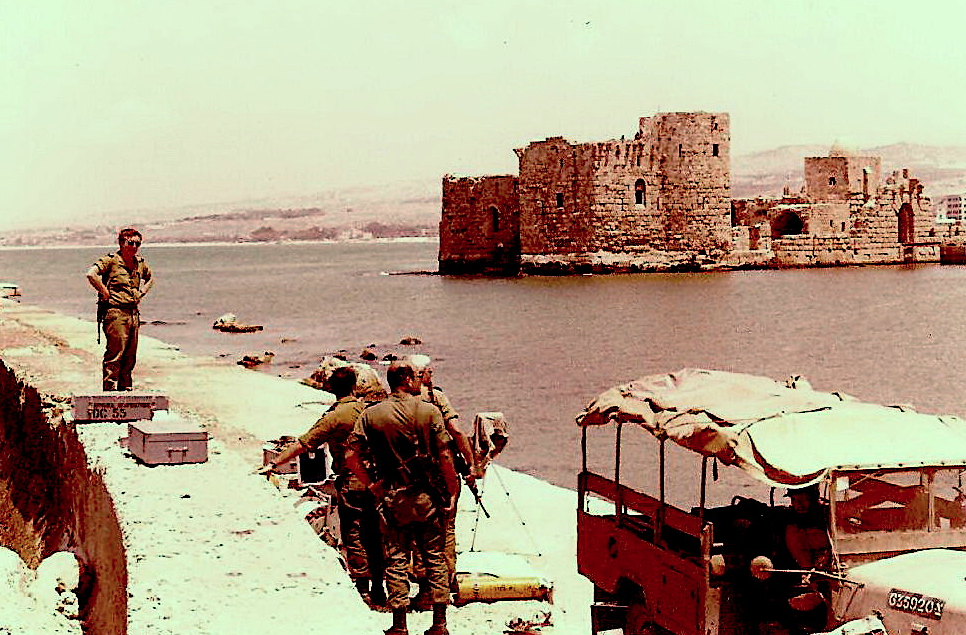
Israeli troops in the Lebanese port city of Sidon, August 1982. (Amnon Tsur Pardes Hana, CC BY-SA 3.0, Wikimedia Commons)
In the July War, by contrast, Israel was shocked to find a force the likes of which it hasn’t seen in the history of the conflict.
These new resistance fighters were of a different mettle and caliber. Israel continued in the war for 33 days until U.S. President George W. Bush got fed up and, allegedly, said something to the effect that: “I’ve given you enough time and you failed; I can’t do more than that.”
[See: THE ANGRY ARAB: Resistance to Israel in the Time of Arafat]
2) When Iran retalialated against Israel this April for the bombing of its consulate in Damascus, Israel’s military weakness was exposed: one night of attacks and Israel could not defend itself alone. It required the military or intelligence assistance of the U.S., Britain, France, Germany, Egypt, Jordan and the U.A.E. In the past, Israel’s military capabilities were such that it sufficed to supposedly defend itself and win against all its enemies without any direct Western support. That clearly is not the case anymore.
3) Due to Israel’s performance in Gaza, the U.S. no longer trusts Israel’s ability in self-defense or offense, especially against the might of Hezbollah. A former deputy national security adviser of Israel predicted that Israel would lose against Hezbollah in 24 hours. This is quite miraculous in the balance of force between Lebanon and Israel. All this agitation against Hezbollah and the daily threats of war (in the Saudi, U.A.E. and some Lebanese media) are the product of Israeli incompetence and perplexity.

U.S. Secretary of State Antony Blinken, center left, meets with Lebanese Prime Minister Najib Mikati, right, in Amman, Jordan, Nov. 4, 2023. (State Department/Chuck Kennedy)
4) The constant threats and intimidation through Western and Arab media are a sign of weakness, not of strength and also of limited horizons. Israel cannot use threats to truly signal the beginning of a war: it is used to attacking without warning. There is a law of diminishing returns that applies to these constant daily threats by Israel against Lebanon.
5) There will develop within the Israeli military-intelligence elite a lobby that is inclined to restrain any propensity to launch an attack on Lebanon. Israel is not a democracy in peacetime and less of one in wartime. The leaders of the army and the Mossad, the national intelligence service, may overrule Netanyahu if he wants to engage in a military adventure for his own political future. Craziness in Israel is usually planned.
6) Hezbollah’s performance during the limited war so far has exceeded expectations in many ways. One is in its tremendous mobility and dynamism, especially in adapting to the developments on the battlefield. Compare the number of casualties for the party in the early days and weeks of the war with the last weeks or so. Hezbollah addressed intelligence and security lapses and identified Israel’s electronic intelligence abilities. It developed deployment methods and rules of engagement with the enemy’s firepower.
The party also resorted to a gradual approach in responding to, or retaliating against, Israeli attacks and has surprised its enemy more than once.
It is also significant that Hezbollah developed the ability to focus exclusively on military targets. Israel has murdered over 80 civilians in South Lebanon since Oct. 7 while Hezbollah killed only one Israeli civilian. That’s a sign of strength not weakness.
The PLO, by contrast, did not deliberately target civilians but it was not informed enough about the enemy to be able to reach military sites. That is something that requires very deliberate and careful work. Hezbollah has achieved that ability over years of experience and training. Israel also knows that Hezbollah has weapons about which it knows very little.
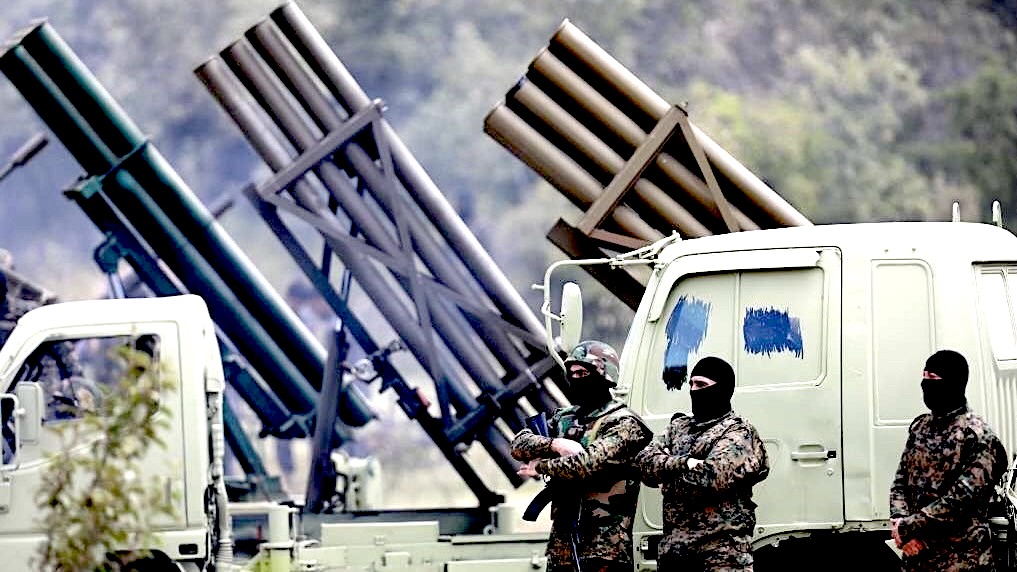
Hezbollah fighters in southern Lebanon, May 2023. (Tasnim News Agency, Wikimedia Commons, CC BY 4.0)
7) Hezbollah’s psychological warfare has possibly influenced the public mood in Israel and may play a role in restraining the adventurism of the Israeli leaders who are threatening war. (It could also have an adverse effect, meaning that the Israeli public may be frightened into wanting a war in the hope of ending the threat of Hezbollah.)
But Israeli leaders know they cannot decisively win a war that easily against Hezbollah. Israel has been unable to win against Hamas. Hezbollah showed tremendous skill in running its military propaganda operations; the videos on social media have scared its enemy.
8) If full-scale war does break out, it would be one of the biggest in the history of the Arab-Israeli conflict and would entail, for sure, regional warfare.
This is what the American administration has been warning Israel against. The U.S. officially informedIsrael that its own estimates indicate that Iran would participate in a war, if it starts, and the cost-benefit calculation may not favor Israel. The scale and size of the war may inflict the biggest harm on Israel since 1948.
Let us remember that the territories occupied by Israel in 1948 have never been directly and strategically hit — not even in the major Arab-Israeli wars.
Finally, it cannot be predicted, one way or another, whether a major war will begin or the outcome of French or American-led negotiations to achieve a ceasefire on the Lebanese-Palestinian border. It is clear though that Israel knows that in Lebanon it faces an enemy like no other.
As`ad AbuKhalil is a Lebanese-American professor of political science at California State University, Stanislaus. He is the author of The Historical Dictionary of Lebanon (1998), Bin Laden, Islam and America’s New War on Terrorism (2002), The Battle for Saudi Arabia (2004) and ran the popular The Angry Arab blog. He tweets as @asadabukhalil
The views expressed are solely those of the author and may or may not reflect those of Consortium News.