

Ankara continues to strengthen its bid for influence in the region by stressing historical and cultural ties.
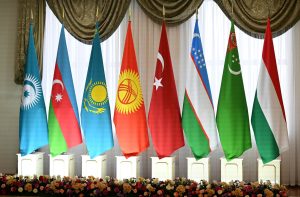
The flags of the member-states of the Organization of Turkic States during the 10th Summit in Astana, Kazakhstan, Nov 3, 2023.
Turkey has decided to replace the term “Central Asia” with “Turkestan” in its national history curriculum. By using the term “Turkestan,” Turkey aims to realign itself with Central Asia while also evaluating the region from its own distinct geopolitical perspective.
The new nomenclature has been received with both support and criticism from various analysts, raising questions about Turkey’s intentions for redefining its role in the region. Although the term “Turkestan” is not new and has a long historical legacy, some argue that recent developments suggest a shift toward a new regionalism. With Russia’s influence waning due to the Ukraine war and China’s growing presence through the Belt and Road Initiative, this move takes on significant importance amid ongoing geopolitical changes.
The term “Turkestan” is historically significant. It refers to the geographic region inhabited by Turkic peoples, encompassing parts of present-day Central Asia, including Kazakhstan, Kyrgyzstan, Uzbekistan, Turkmenistan, and China’s Xinjiang region. Widely used before the Russian occupation in the 19th century, “Turkestan” gradually fell out of favor, replaced by the more neutral term “Central Asia.” This shift beganwhen geographer Alexander von Humboldt first used the term in 1843. Its spread mirrors the adoption of terms like “Middle East” or “Near East,” which gained traction through the research of Alfred Thayer Mahan, one of the founders of geopolitics, and were later embraced by Western countries.
In the early days of the Soviet Union, what is now Central Asia was governed by the Turkestan Autonomous Soviet Socialist Republic, established in 1918. This autonomous structure was intended by the Soviet leadership to unite the ethnic groups in the region and spread socialist ideology. The use of this term during this period, which constituted the first phase of Soviet domination of the region, was also intended to gain the sympathy of the peoples living there.
During the 1920s, as part of its nationalities policy, the Soviet Union divided Turkestan, creating the Kazakh, Kyrgyz, Uzbek, Turkmen, and Tajik Soviet Socialist Republics. This effectively abolished the name “Turkestan” and emphasized the region’s ethnic divisions, strengthening Soviet centralized control. In subsequent years, the use of the Latin alphabet was banned, and the Cyrillic alphabet and Russian language were imposed. By adopting the term “Central Asia,” the Soviets further downplayed the region’s Turkic ethnic and historical unity.
Today, Turkey and the Turkic republics embrace the concept of the “Turkic World” as a response to this historical fragmentation.
Historian Lev Gumilev has emphasized the importance of Turkish ethnicity within the Eurasian landscape and criticized a purely Russian-centered approach to Eurasianism. According to Gumilev, Turks, Tatars, and Mongols have all shaped the region’s dynamics by adapting to the historical and geographical conditions of Eurasia. Through interactions with various ethnic groups, Turkic ethnicity has played a central role in shaping Eurasia’s complex history and culture. Gumilev argued that, alongside the Russians, the Turks emerged as one of the region’s major powers due to their transformative historical and political role, contributing to the balance of power with their cultural richness.
Turkey’s New Regionalism and Pan-Turkism Debates
For Turkey, the term “Turkestan” reflects a desire to reconnect with Turkic-speaking peoples and revive a shared historical and cultural consciousness. This vision, along with the concept of the “Turkic World,” has been embraced by both the state and the public since the early 1990s. Turkey has aimed to build partnerships in the region on equal terms, leveraging the unifying power of shared culture to strengthen economic and political ties. As former President Süleyman Demirel famously stated: “The Turkic world stretches from the Adriatic Sea to the Great Wall of China.” The country has shaped its regional policies under this view.
In line with new Turkish regionalism, institutions such as the Parliamentary Assembly of Turkic Speaking Countries, the International Organization of Turkic Culture, the International Turkic Academy, the Turkic Culture and Heritage Foundation, the Turkic Business Council, the Turkic University Union, and the Turkic Chamber of Commerce and Industry have been established. Currently, the Organization of Turkic States (OTS) – formerly known as the Turkic Council – is the largest organization.
Turkey’s curriculum change aligns with the goals of the OTS, which also includes Kazakhstan, Uzbekistan, Kyrgyzstan, and Azerbaijan as members. The OTS has taken significant steps toward establishing common educational and cultural policies, including joint initiatives to create shared histories, geographic frameworks, and now even a common alphabet. These efforts are seen as symbolic of Turkey’s growing soft power and influence within the Turkic world.
An important development preceding the curriculum change was the OTS’s announcement of the adoption of a Latin-based common Turkic alphabet, a crucial step toward linguistic unification. By promoting the Latin alphabet and reintroducing the term “Turkestan,” Turkey is making a strategic geopolitical move. This initiative represents a shift in Turkey’s foreign policy, aimed at expanding its influence in Central Asia. It is also viewed as aligning with Pan-Turkist intellectual Ismail Gaspırali’s motto of “unity in language, work and ideas,” reinforcing the vision of greater Turkic solidarity.
In light of these developments, various countries question whether Turkey is pursuing a pan-Turkic policy. Russia in particular is skeptical of Turkey’s motivations. This month, the U.S. Helsinki Commission Staff published a report titled “Contesting Russia: Preparing for the Long-Term Russian Threat,” which argued that Turkey should be considered as an alternative power to Russia. To that end, the report recommended that the United States should offer support for Turkey’s Pan-Turkic initiatives.
Although Turkey claims that its goal is unity with the Turkic-speaking peoples of the region, the term “Turkestan” has its handicaps. For instance, it remains unclear for the time being how the term will account for Tajiks and other ethnic groups living in the region. In addition, the approach of other actors in the region to this issue will also become clearer in the coming period.
This move is expected to have significant geopolitical implications, particularly for Turkey’s relations with Russia, Iran, and China. Russia has historically viewed Central Asia as part of its sphere of influence and continues to consider the region integral to its “near abroad policy.” China, meanwhile, exerts substantial economic and political influence in the region, especially in Xinjiang, home to the Turkic-speaking Uyghurs. Turkey’s adoption of the term “Turkestan” could raise concerns in Moscow, Tehran, and Beijing, as it may be seen as an effort to counterbalance their influence in the region.
One example of this dynamic is the Ashgabat Forum held in Turkmenistan on October 12. Some observers suggest that the sudden and heightened interest from Russia and Iran in Turkmenistan is a direct response to Turkey’s engagement in the region. Additionally, some analysts contend that such an initiative may be imprudent, considering Turkey’s aspirations within BRICS.
Consequently, Turkey is signaling its intention to shape the new geopolitical reality in the region. Amid the ongoing Russia-Ukraine war and China’s extensive economic projects, Turkey it trying to assert its presence on the global stage. This initiative aligns with a broader trend in Central Asia, where countries like Kazakhstan and Uzbekistan are increasingly distancing themselves from Russia and seeking closer ties with the Turkic world. By positioning itself as the region’s foremost cultural and political partner, Turkey is poised to enhance its role in shaping the future of Central Asia.